
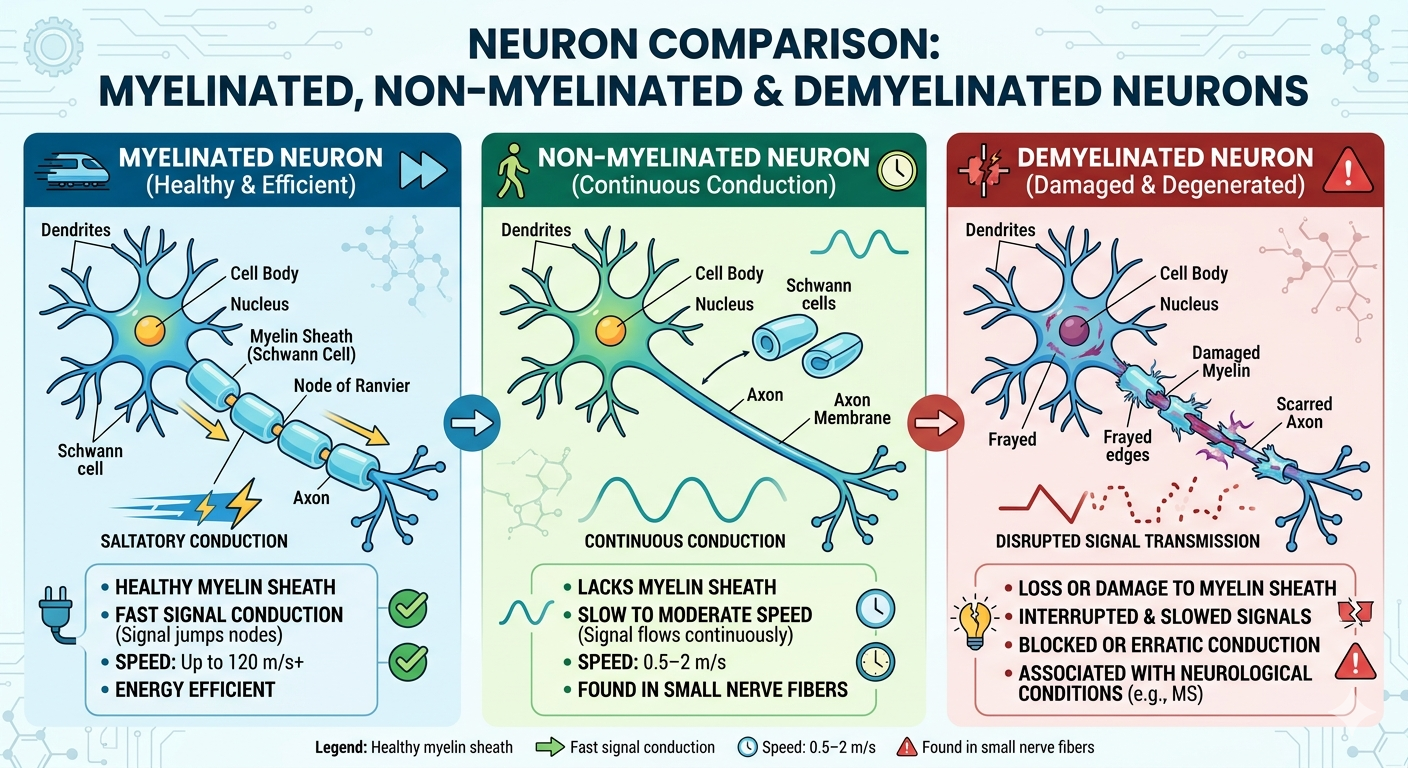
If you grew up during the low-fat diet craze of the 1990s, you might still feel a little ping of guilt when you reach for full-fat yogurt, grass-fed butter, or a drizzle of olive oil. For decades, we were told that fat was the enemy.
But there is one organ in your body that looks at a low-fat diet and genuinely panics: your brain.
The human brain is the most cholesterol-rich organ in the body[^1]. A huge portion of that fat isn’t there for storage; it is actively working as a specialized, high-tech insulation system for your nervous system[^2]. Today, we are going to look at a beautiful biological structure called the myelin sheath and explore exactly why eating healthy fats—including saturated fats—is non-negotiable for a sharp, fast-thinking mind.
What is Myelin, Anyway?
Imagine your nervous system as a massive, complex network of electrical wires. Every time you decide to wiggle your toes, recall a childhood memory, or blink your eyes, your brain sends an electrical impulse down a long nerve fiber called an axon.
If that nerve fiber were bare, the electrical signal would travel incredibly slowly, leaking current along the way. To prevent this, nature invented myelin.
Myelin is a specialized, multi-layered membrane wrapped tightly around your nerve fibers[^3]. Think of it exactly like the plastic coating around a laptop charger. It keeps the electrical signal contained, prevents it from short-circuiting, and helps it travel at lightning speed[^4].
- Without Myelin: Nerve signals crawl at a sluggish 1 to 4 miles per hour.
- With Myelin: Nerve signals rocket through your body at over 260 miles per hour!
The Recipe for Myelin: The Structural Role of Saturated Fat
So, where does fat come into the story? Myelin isn’t just a simple tissue; it is characterized by an exceptionally high proportion of lipids (fats), making up 70% to 85% of the sheath[^5].
While we often hear about the benefits of unsaturated fats like omega-3s, saturated fat is actually a primary structural backbone of the myelin sheath[^6].
Think about the physical difference between fats at room temperature: unsaturated fats (like olive oil) are fluid liquids, while saturated fats (like butter or coconut oil) are stable and solid. Your myelin sheath needs that exact structural stability.
- Building a Dense, Insulating Wall: The long, straight molecular structure of saturated fatty acid side chains allows them to pack tightly together[^7]. This tight packing creates the highly dense, waterproof barrier required to insulate an electrical current and prevent ion leakage[^8].
- The Cholesterol Companion: Saturated fats work hand-in-hand with cholesterol, which is the single most abundant lipid found in myelin[^9]. Cholesterol acts as a rigid anchor, reducing water penetration and maintaining the tight packing density of the membrane so it doesn’t lose its shape[^10].
When myelin breaks down—a process called demyelination—the results can be severe. In conditions like Multiple Sclerosis (MS), the body’s immune system mistakenly attacks this fatty coating, leading to short-circuited nerve pathways, vision problems, and muscle weakness[^11].
Feed Your Sheaths: The Best Fats for Brain Health
Your body is constantly maintaining and remodeling your myelin[^12]. To do that job well, it needs a balanced mix of raw materials. Here are the fat-rich foods that your nervous system loves:
- High-Quality Saturated Fats: Found in grass-fed butter, ghee, coconut oil, and eggs. Eggs are an excellent choice because they are rich in sphingomyelin and phosphatidylcholine, which are vital phospholipids used directly in peripheral nerve membranes[^13].
- Omega-3 Fatty Acids: Found in fatty fish (salmon, mackerel, sardines), walnuts, and flaxseeds. These polyunsaturated fats keep the outer cell membranes healthy and support the glial cells (like oligodendrocytes) that actively manufacture myelin[^14].
- Monounsaturated Fats: Found in abundance in avocados, olive oil, and almonds. These fats help support overall cellular metabolism and reduce systemic inflammation.
The Takeaway
The next time you sit down for a meal, remember that you aren’t just feeding your muscles or your stomach—you are fueling a 260-mph electrical grid inside your head.
A healthy brain thrives on balance. While artificial trans fats (like those in heavily processed junk food) should be avoided, natural fats—both unsaturated and saturated—are the structural components keeping your mind fast and insulated. Embrace the healthy fats; your myelinated neurons will thank you for it!
References
[^1]: Orth, M., & Bellosta, S. (2012). Cholesterol: Its regulation and role in central nervous system disorders. Cholesterol, 2012, 1-19. https://doi.org/10.1155/2012/292598
Cited by: 419
[^2]: Barnes-Vélez, J. A., Aksoy Yasar, F. B., & Hu, J. (2023). Myelin lipid metabolism and its role in myelination and myelin maintenance. The Innovation, 4(1), 100360. https://doi.org/10.1016/j.xinn.2022.100360
Cited by: 143
[^3]: Poitelon, Y., Kopec, A. M., & Belin, S. (2020). Myelin fat facts: An overview of lipids and fatty acid metabolism. Cells, 9(4), 812. https://doi.org/10.3390/cells9040812
Cited by: 484
[^4]: Kister, A., & Kister, I. (2023). Overview of myelin, major myelin lipids, and myelin-associated proteins. Frontiers in Chemistry, 10, 1041961. https://doi.org/10.3389/fchem.2022.1041961
Cited by: 189
[^5]: Poitelon, Y., Kopec, A. M., & Belin, S. (2020). Myelin fat facts: An overview of lipids and fatty acid metabolism. Cells, 9(4), 812. https://doi.org/10.3390/cells9040812
Cited by: 484
[^6]: Ho, P. P., Kanter, I. L., Johnson, A. M., Srinagesh, H. K., Chang, E. J., Purdy, T. M., van Haren, K., Wikoff, W. R., Kind, T., Khademi, M., Matloff, L. Y., Narayana, S., Hur, E. M., Lindstrom, T. M., He, Z., Fiehn, O., Olsson, T., Han, X., Han, M. H., Steinman, L., & Robinson, W. H. (2012). Identification of naturally occurring fatty acids of the myelin sheath that resolve neuroinflammation. Science Translational Medicine, 4(137). https://doi.org/10.1126/scitranslmed.3003831
Cited by: 78
[^7]: Ho, P. P. et al. (2012). Identification of naturally occurring fatty acids of the myelin sheath that resolve neuroinflammation. Science Translational Medicine, 4(137). https://doi.org/10.1126/scitranslmed.3003831
Cited by: 78
[^8]: Kister, A., & Kister, I. (2023). Overview of myelin, major myelin lipids, and myelin-associated proteins. Frontiers in Chemistry, 10, 1041961. https://doi.org/10.3389/fchem.2022.1041961
Cited by: 189
[^9]: Barnes-Vélez, J. A., Aksoy Yasar, F. B., & Hu, J. (2023). Myelin lipid metabolism and its role in myelination and myelin maintenance. The Innovation, 4(1), 100360. https://doi.org/10.1016/j.xinn.2022.100360
Cited by: 143
[^10]: Kister, A., & Kister, I. (2023). Overview of myelin, major myelin lipids, and myelin-associated proteins. Frontiers in Chemistry, 10, 1041961. https://doi.org/10.3389/fchem.2022.1041961
Cited by: 189
[^11]: Ho, P. P. et al. (2012). Identification of naturally occurring fatty acids of the myelin sheath that resolve neuroinflammation. Science Translational Medicine, 4(137). https://doi.org/10.1126/scitranslmed.3003831
Cited by: 78
[^12]: Barnes-Vélez, J. A., Aksoy Yasar, F. B., & Hu, J. (2023). Myelin lipid metabolism and its role in myelination and myelin maintenance. The Innovation, 4(1), 100360. https://doi.org/10.1016/j.xinn.2022.100360
Cited by: 143
[^13]: Poitelon, Y., Kopec, A. M., & Belin, S. (2020). Myelin fat facts: An overview of lipids and fatty acid metabolism. Cells, 9(4), 812. https://doi.org/10.3390/cells9040812
Cited by: 484
[^14]: Poitelon, Y., Kopec, A. M., & Belin, S. (2020). Myelin fat facts: An overview of lipids and fatty acid metabolism. Cells, 9(4), 812. https://doi.org/10.3390/cells9040812
Cited by: 484