
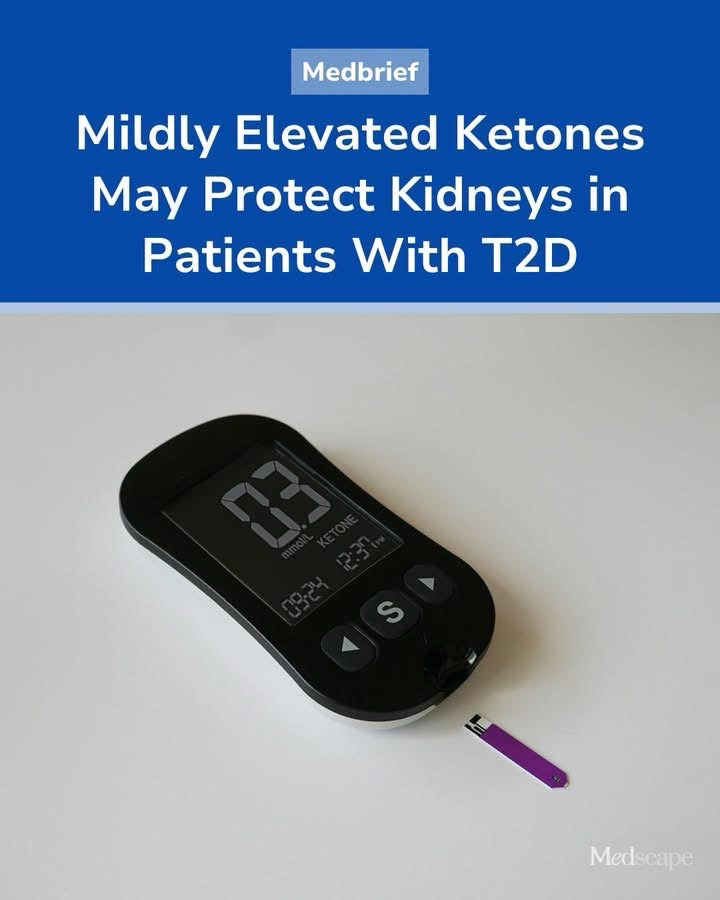
A research team from Korea University Anam Hospital recently published a study in Diabetes Research and Clinical Practice that asked a fairly provocative question: is there a relationship between circulating ketone levels in people with type 2 diabetes and their long-term kidney and cardiovascular outcomes?
The question itself cuts against the grain. For decades, ketones in the diabetes-care conversation have mostly been shorthand for danger — ketoacidosis, emergency rooms, red flags. But what this study found points in a very different direction.
How the study was done
Researchers followed 1,392 clinically stable patients with type 2 diabetes, deliberately excluding anyone on insulin or thiazolidinedione medications — this removes a major confounder, since both treatments affect ketone metabolism directly.
Blood ketone levels were measured during routine, stable outpatient visits, and participants were split into three groups:
- Low: 0.08–92.3 µmol/L
- Middle: 92.7–170.8 µmol/L
- High: 171.0–1629.6 µmol/L
Over a median follow-up of 23.2 months, researchers tracked kidney outcomes (new macroalbuminuria, a ≥40% drop in eGFR, or progression to end-stage kidney disease) and cardiovascular events.
What they found
Across the follow-up period, there were 158 kidney events and 64 cardiovascular events. The pattern that emerged was fairly consistent:
People in the highest ketone group had notably better kidney outcomes than those in the lowest group — a 37% lower risk of composite adverse kidney events overall. Looking specifically at the ≥40% eGFR decline, the risk was 54% lower in the high-ketone group. And among participants who started with normal kidney function (eGFR ≥60), those with higher ketones were 50% less likely to go on to develop chronic kidney disease.
Cardiovascular outcomes trended in the same favorable direction, but the numbers of events were too small to reach statistical significance.
The researchers also identified a “sweet spot” — the lowest kidney risk clustered around ketone levels of roughly 300–400 µmol/L. That’s a mild, low-grade elevation — nowhere near the levels seen in deeper nutritional ketosis (which can run into the thousands), and far below the threshold for dangerous ketoacidosis (typically above 3,000 µmol/L).
This lines up with what we already knew
If you’ve followed the research on SGLT2 inhibitors (“glucose-dumping” diabetes drugs) and kidney protection, this direction won’t come as a total surprise. One well-known side effect of these drugs is a mild rise in ketone levels, and SGLT2 inhibitors are also some of the most consistently kidney-protective drugs in major diabetes trials.
The leading mechanistic explanation is that beta-hydroxybutyrate — the main circulating ketone — can serve as an efficient alternative fuel for kidney cells, ease the load on mitochondria, and dial down inflammation and oxidative stress. These are exactly the pathways implicated in diabetic kidney disease.
In a sense, this new study approaches the same underlying biology from a different angle — not through a drug, but by observing naturally occurring ketone levels in the body — and arrives at a consistent story.
What this means if you’re following a low-carb or ketogenic approach
My own read on where this study sits: it isn’t a green light to chase ever-higher ketone numbers. But it is a fairly reassuring signal — mild, sustained ketosis, at least in this cohort, wasn’t associated with kidney harm. If anything, it tracked alongside better kidney outcomes.
That runs directly counter to a common claim that ketones are inherently hard on the kidneys. Of course, none of this replaces the fundamentals — blood pressure control, glycemic management — and it isn’t a reason to deliberately push ketone levels higher for their own sake. What it does is add one more piece of evidence that mild ketosis appears safe, and possibly beneficial, for kidney health in type 2 diabetes.
Reference:
Shin, S. M., Lee, J., Kim, Y., et al. (2026). Serum ketone body levels and risk of incident kidney and cardiovascular events among patients with type 2 diabetes: A prospective cohort study. Diabetes Research and Clinical Practice, 239, 113476.