
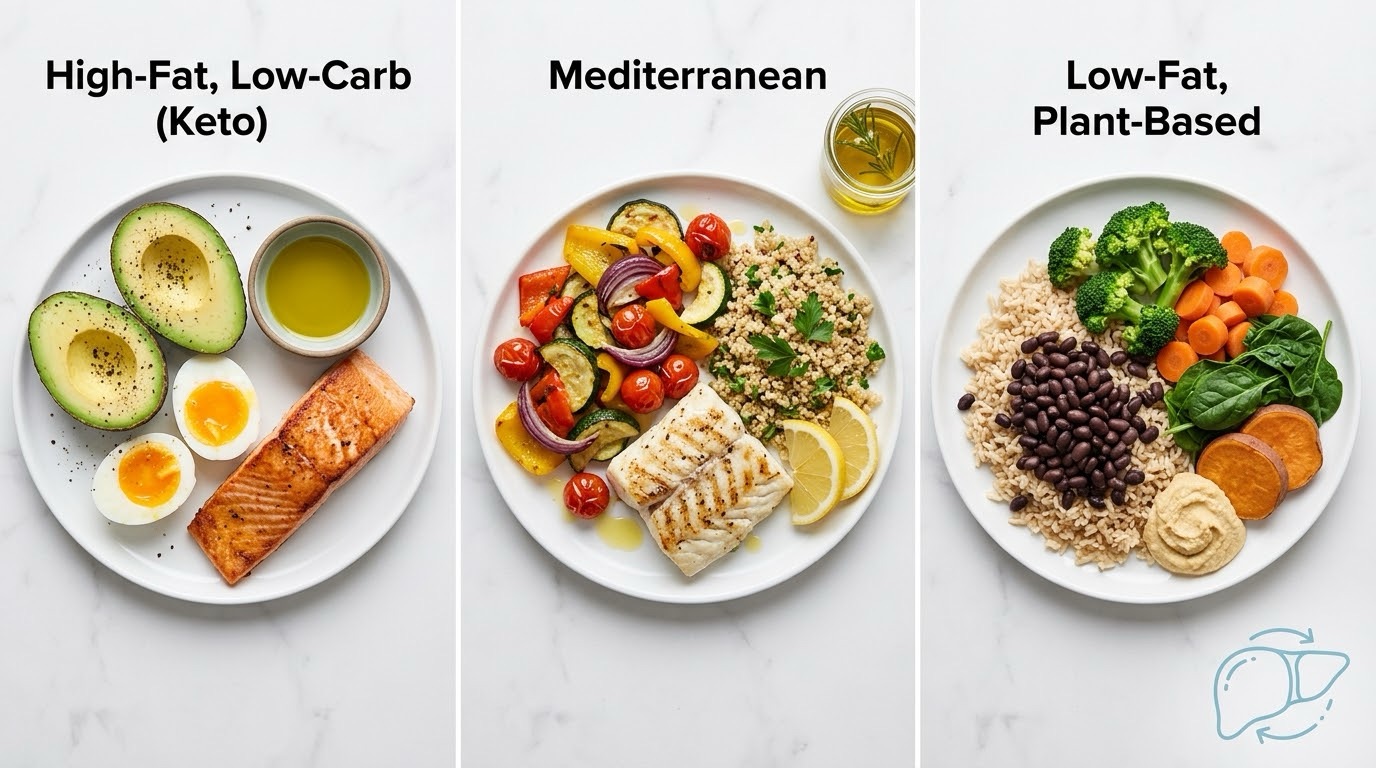
If you follow low-carb or keto content, you’ve probably already seen people sharing this study. It was published in Cell Metabolism and comes out of Washington University School of Medicine — not a random internet claim, but a properly designed randomized controlled trial. Let’s break down what it actually says.
How the study was designed
Researchers recruited 42 people who all had obesity, prediabetes, and fatty liver disease. They were randomly split into three groups, each following a different diet:
- Ketogenic: 4% of calories from carbs, 73% from fat
- Mediterranean: 50% from carbs, 35% from fat
- Low-fat, plant-forward: 70% from carbs, 15% from fat
What makes this trial solid is the control: researchers supplied all the food, and participants met with a dietitian every week to make sure they actually stuck to the plan. Even more important — calorie intake was individually adjusted so that all three groups lost roughly the same amount of weight: about 10% of body weight. That took around four to five months.
Why does that matter? Because it isolates the effect of diet composition from the effect of weight loss itself. If keto did better, it wouldn’t just be because people lost more weight.
Same weight loss, very different results
All three groups improved — body fat dropped and insulin sensitivity got better across the board. But once you look at liver fat and blood sugar markers specifically, the differences show up clearly:
Liver fat reduction
Keto: 67% average drop. Mediterranean and low-fat: about 45% each.
Prediabetes reversal
About half the keto group no longer met the criteria for prediabetes by the end of the trial. In the Mediterranean group it was 29%. In the low-fat group, just 7%.
Hormonal changes
The keto group had the biggest rise in glucagon, a hormone that helps clear fat out of the liver. They also had the sharpest drop in insulin of the three groups.
The most surprising finding
First author Max Petersen pointed out something that goes against a lot of people’s assumptions: even though the keto group ate the most fat by far, their blood lipids and cholesterol didn’t go up. That challenges the reflexive “eating more fat means your cholesterol will spike” belief, and it lines up with what several other low-carb studies have been showing in recent years.
Senior author Samuel Klein made the bigger-picture point: we already know weight loss alone improves metabolic health. What this study adds is that for people with high liver fat and prediabetes specifically, cutting carbohydrates may offer therapeutic benefits beyond what weight loss alone provides.
How much weight should this carry
The trial is well-designed — food was fully controlled and adherence was closely monitored, which makes the data more trustworthy than most diet studies. That said, a few caveats are worth keeping in mind:
- It only ran for four to five months. Longer-term effects and safety still need more research.
- Participants already had obesity, prediabetes, and fatty liver — the results may not generalize to a healthy general population.
- All meals were prepared by the research team. Hitting these exact macro ratios in real life is a lot harder without that support.
For anyone already doing low-carb or keto, this is a solid piece of scientific support — particularly around liver fat and blood sugar control. But diet is still highly individual, and any real change should ideally be tracked with a doctor or dietitian.
Reference: Petersen MC, Smith GI, Farabi SS, et al. Effect of diet macronutrient content on the cardiometabolic response to weight loss: A randomized clinical trial. Cell Metabolism, 2026.