
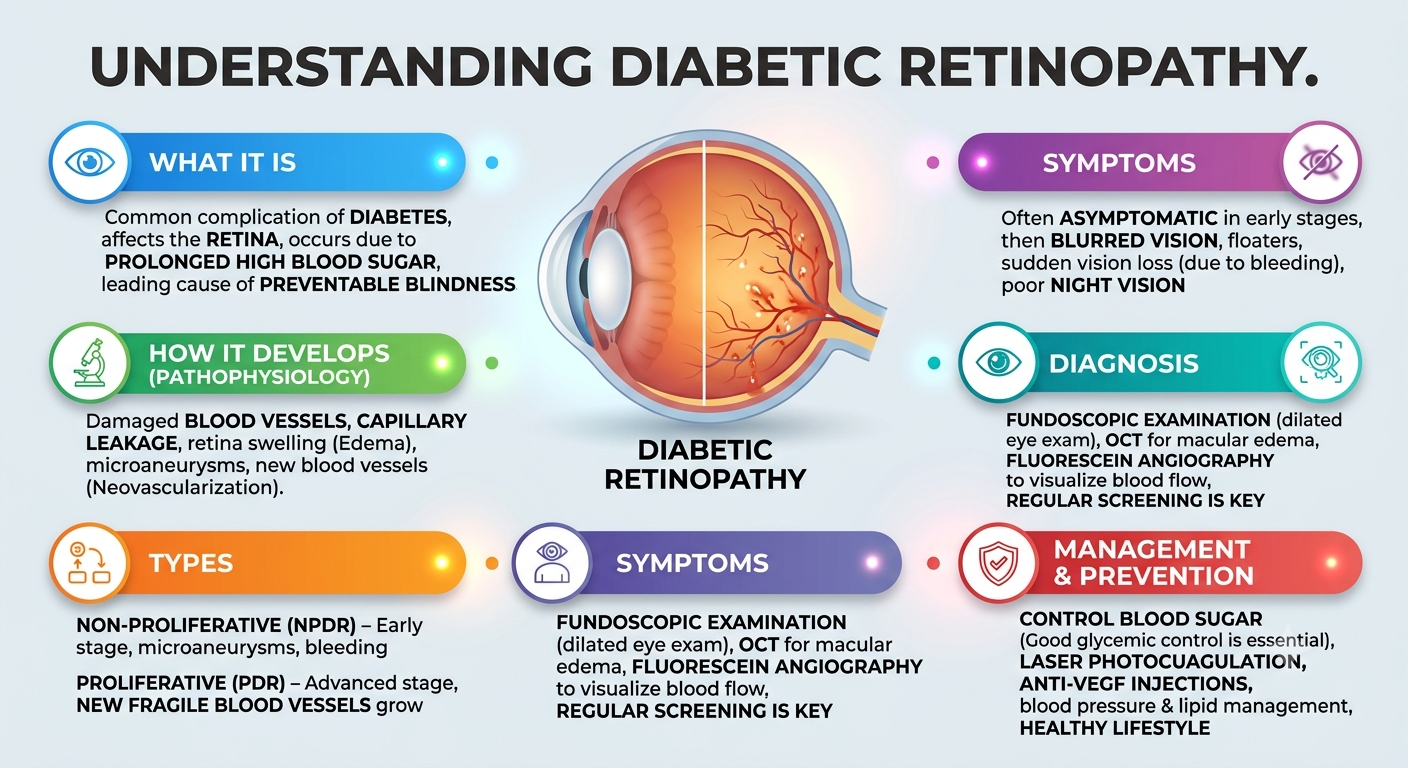
If you or someone you love has diabetes, there’s a health issue that doesn’t get talked about nearly enough — and that’s a shame, because it’s one of the leading causes of preventable blindness in the world. It’s called diabetic retinopathy, and the scary part is that it can be quietly damaging your vision for years before you notice anything wrong.
What exactly is it?
Diabetic retinopathy happens when years of high blood sugar slowly damage the tiny blood vessels in your retina — the light-sensitive layer at the back of your eye that lets you actually see. Think of these vessels as delicate plumbing. When sugar levels stay high for too long, that plumbing starts to leak, weaken, and eventually get blocked. The retina, starved of proper blood flow, doesn’t function the way it should, and vision starts to suffer.
Here’s the part that catches people off guard: in the early stages, there are usually no symptoms at all. You could be losing ground on your eye health and feel completely fine. That’s exactly why regular eye screening matters so much for anyone living with diabetes — by the time you notice blurry vision or floaters, the disease may have already progressed.
How it develops
Doctors generally describe two stages. The first is non-proliferative diabetic retinopathy, or NPDR — the earlier, milder form. At this point you might see small bulges in the blood vessels (called microaneurysms), tiny hemorrhages, or fatty deposits called hard exudates. It’s the eye’s way of showing early wear and tear.
If left unchecked, it can progress to proliferative diabetic retinopathy, or PDR. This is the more serious stage, where the retina, starved of oxygen, tries to compensate by growing new blood vessels. Unfortunately, these new vessels are fragile and poorly formed — they bleed easily, and that bleeding (called vitreous hemorrhage) can cause sudden, dramatic vision loss.
Warning signs to watch for
Since early diabetic retinopathy is silent, it’s often only in the later stages that people notice:
- Blurred vision or spots/floaters drifting across their sight
- Trouble seeing clearly at night
- Sudden vision loss, which can be alarming and requires immediate medical attention
If any of these show up, don’t wait it out — get to an eye doctor right away.
How doctors catch it
The good news is that diabetic retinopathy is very detectable with the right tools. An eye doctor can spot early changes through a simple dilated eye exam (fundoscopy). For a closer look, they might use optical coherence tomography (OCT) to check for swelling in the macula, or fluorescein angiography, which uses a special dye to map out how blood is flowing through the retina. None of these tests are especially invasive, and catching problems early makes an enormous difference in how treatable they are.
What can be done about it
Treatment depends on how advanced things are, but there are real, effective options:
- Getting blood sugar under control is still the single most powerful thing you can do — it slows or even halts progression.
- Laser photocoagulation can seal off leaking vessels in more advanced cases.
- Anti-VEGF injections help calm down that abnormal vessel growth.
- In severe situations involving significant bleeding, a surgical procedure called vitrectomy may be needed.
- Keeping blood pressure and cholesterol in check also plays a bigger supporting role than people realize.
The best strategy? Prevention.
Honestly, the most powerful tool against diabetic retinopathy isn’t a laser or an injection — it’s consistency. Keeping blood sugar levels steady, getting your eyes checked regularly (even when your vision feels perfectly fine), managing blood pressure and cholesterol, and living an overall healthy lifestyle can dramatically lower your risk of ever reaching the more serious stages.
If you have diabetes, don’t skip your eye exams because your vision “seems fine.” This disease has a habit of hiding until it’s already done damage. A yearly check-up is a small time investment that can protect one of your most valuable senses for decades to come.