
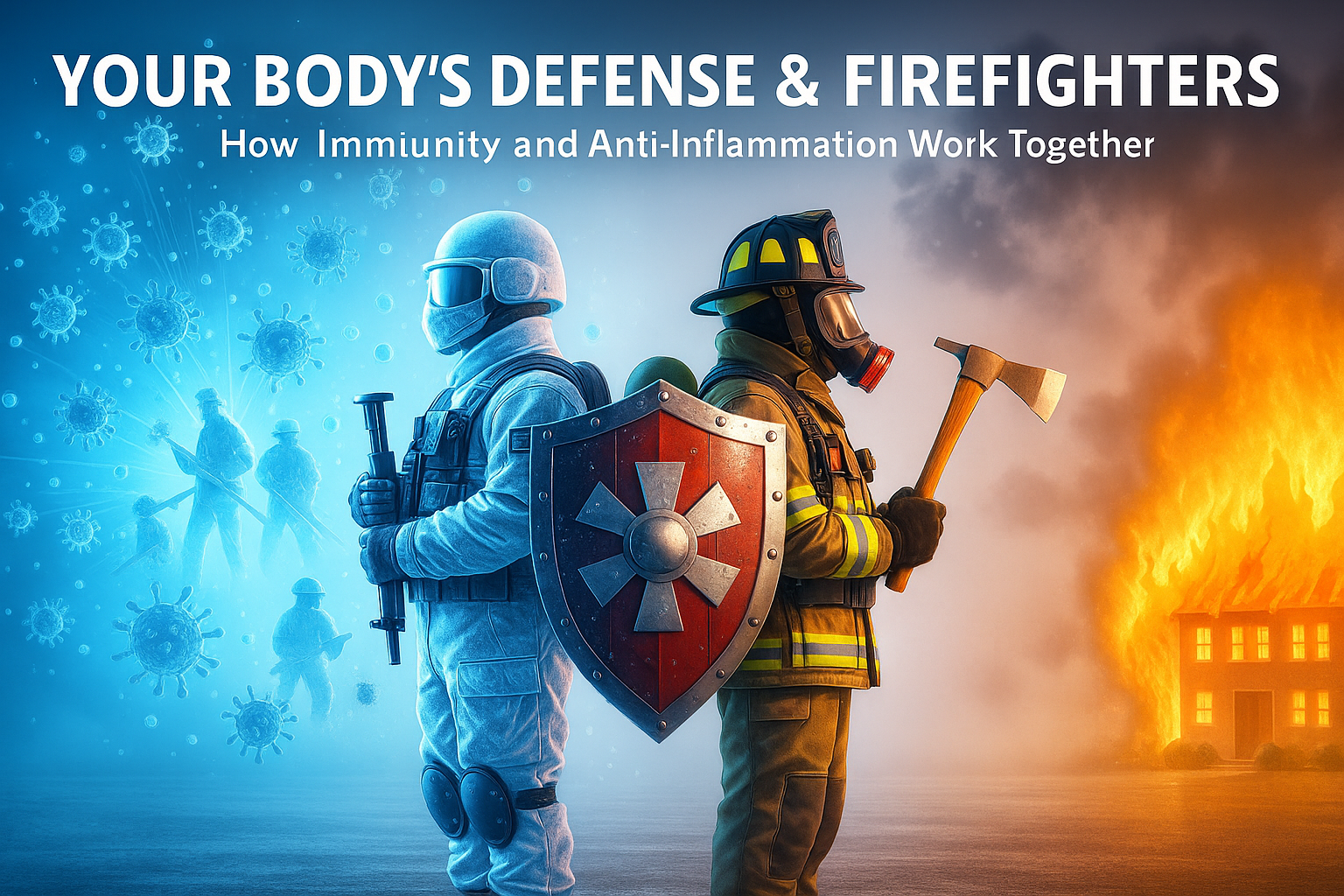
Imagine your body as a living, breathing nation — an incredible world within you. Every second, millions of microscopic citizens work together to keep peace, build energy, and maintain order.
Just like any thriving country, there are invisible threats — viruses, bacteria, toxins, and even stress — that constantly try to invade or disrupt harmony. But your body isn’t defenseless. It has a brilliant system of protection and recovery, carefully designed to fight danger and restore peace when the battle is over.
In this biological nation, your white blood cells act as the Defense Department — the trained military that guards the borders and strikes when invaders attack. They are always alert, scanning for any sign of trouble, ready to sacrifice themselves for your safety.
But when these soldiers go to war, they often leave behind destruction — burning tissues, chemical “smoke,” and collateral damage. That’s when another vital force must arrive: the Firefighters, your anti-inflammatory system, whose mission is to put out the flames, rebuild what’s broken, and restore calm across the land.
Both of these forces — the fighters and the healers — are essential. Without soldiers, your body would fall to infections. Without firefighters, your body would burn from within. And just like in any nation, neither can function without resources and fuel — the essential nutrients that keep them disciplined, focused, and effective.
🩸 The Defense Department: White Blood Cells
Your white blood cells (WBCs) are the elite defenders of your body. They patrol your bloodstream and lymph system, ready to attack anything that doesn’t belong.
Each troop has a unique role:
- Neutrophils: frontline infantry, first to arrive when bacteria invade.
- Lymphocytes (T cells and B cells): intelligence units, gathering information and creating long-term memory.
- Macrophages: battlefield commanders, devouring the enemy and coordinating the immune response.
When a pathogen invades, these troops unleash a full-scale defense — inflammation. This heat, redness, and swelling isn’t just discomfort; it’s the sound of the battle raging within.
🍳 Essential Nutrients for the Defense Department
Zinc – The Signal Commander: Helps immune cells communicate and multiply effectively. Sources include meat, shellfish, eggs, and pumpkin seeds.
Vitamin C – The Weapon Engineer: Enhances the killing power of white blood cells and shields them from oxidative stress. Sources include citrus fruits, peppers, broccoli, and berries.
Vitamin D – The Strategic General: Regulates immune responses and prevents overactivation that can cause autoimmunity. Sources include sunlight, fatty fish, and egg yolks.
Protein & Amino Acids – The Soldier’s Armor: Build the structure of immune cells and enzymes. Found in meat, fish, collagen bone broth, and eggs.
Omega-3 (EPA/DHA) – The Communication Satellite: Balances immune activity and prevents excessive attacks. Found in deep-sea fish, fish oil, and chia seeds.
MCT oil – provides the immune system with quick, clean energy by converting into ketones, enhances gut immunity, and reduces metabolic inflammation by stabilizing blood sugar and insulin.
🔥 The Firefighters: Anti-Inflammation
When the war ends, the battlefield still burns. Tissues swell, cells break down, and chemical “smoke” fills the area. That’s when the anti-inflammatory team arrives — your firefighters. Their mission is to cool the flames, rebuild the city, and restore order.
They release resolving molecules that tell immune cells to stand down, clean up the mess, and start healing. Without these heroes, the fire never ends — leading to chronic inflammation, tissue scarring, and diseases like arthritis, atherosclerosis, and heart disease.
🌿 Essential Nutrients for the Firefighters
Omega-3 Fatty Acids – The Fire Extinguishers: Converted into resolvins and protectins that actively turn off inflammation. Found in salmon, sardines, and mackerel.
Magnesium – The Calm Mediator: Reduces stress hormones and relaxes blood vessels to ease inflammation. Found in nuts, seeds, avocados, and greens.
Vitamin E – The Protective Shield: Guards cells from oxidative damage during recovery. Found in sunflower seeds, almonds, and olive oil.
Polyphenols – The Smart Fire Sensors: Switch off inflammatory genes and repair oxidative damage. Found in green tea, turmeric, berries, and cocoa.
Collagen & Glycine – The Rebuilders: Provide the raw materials for tissue repair and wound healing. Found in bone broth, slow-cooked meats, and fish skin.
Astaxanthin – strengthens immune cell membranes, regulates immune balance, and actively resolves inflammation through the production of resolvins and protectins. Found in krill oil.
🧩 In Summary
White Blood Cells (Defense)
- Role : Protect and attack invaders
- Nutrient : Zinc, Vitamin C, D, Protein, Omega-3
- Food Source : Meat, eggs, seafood, bone broth
Anti-Inflammatory (Firefighters)
- Role : Cool, repair, restore
- Nutrient : Omega-3, Magnesium, Vitamin E, Polyphenols, Collagen
- Fish, greens , Red palm oil, bone broth
⚖️ Balance Is the Real Power
A nation without soldiers will fall. A nation without firefighters will burn. Your health depends on balance — strong immunity that fights when necessary, and strong recovery that cools and rebuilds afterward.
Modern lifestyles often tip the scale — too much sugar, stress, or processed food can keep your soldiers overactive and your firefighters too weak to restore peace. That’s why a nutrient-dense, low-carb, anti-inflammatory diet provides steady fuel for both — protecting your inner nation from chaos.
📚 References
1. Medzhitov R. Origin and physiological roles of inflammation. Nature. 2008;454(7203):428–435.
2. Calder PC. Nutrition and immunity: lessons for COVID-19. BMJ Nutr Prev Health. 2020;3(1):74–92.
3. Serhan CN, Levy BD. Resolvins in inflammation: emergence of the pro-resolving superfamily. J Clin Invest. 2018;128(7):2657–2669.
4. Maggini S, et al. Selected vitamins and trace elements support immune function by strengthening epithelial barriers and cellular immunity. Br J Nutr. 2018;119(7):785–795.