
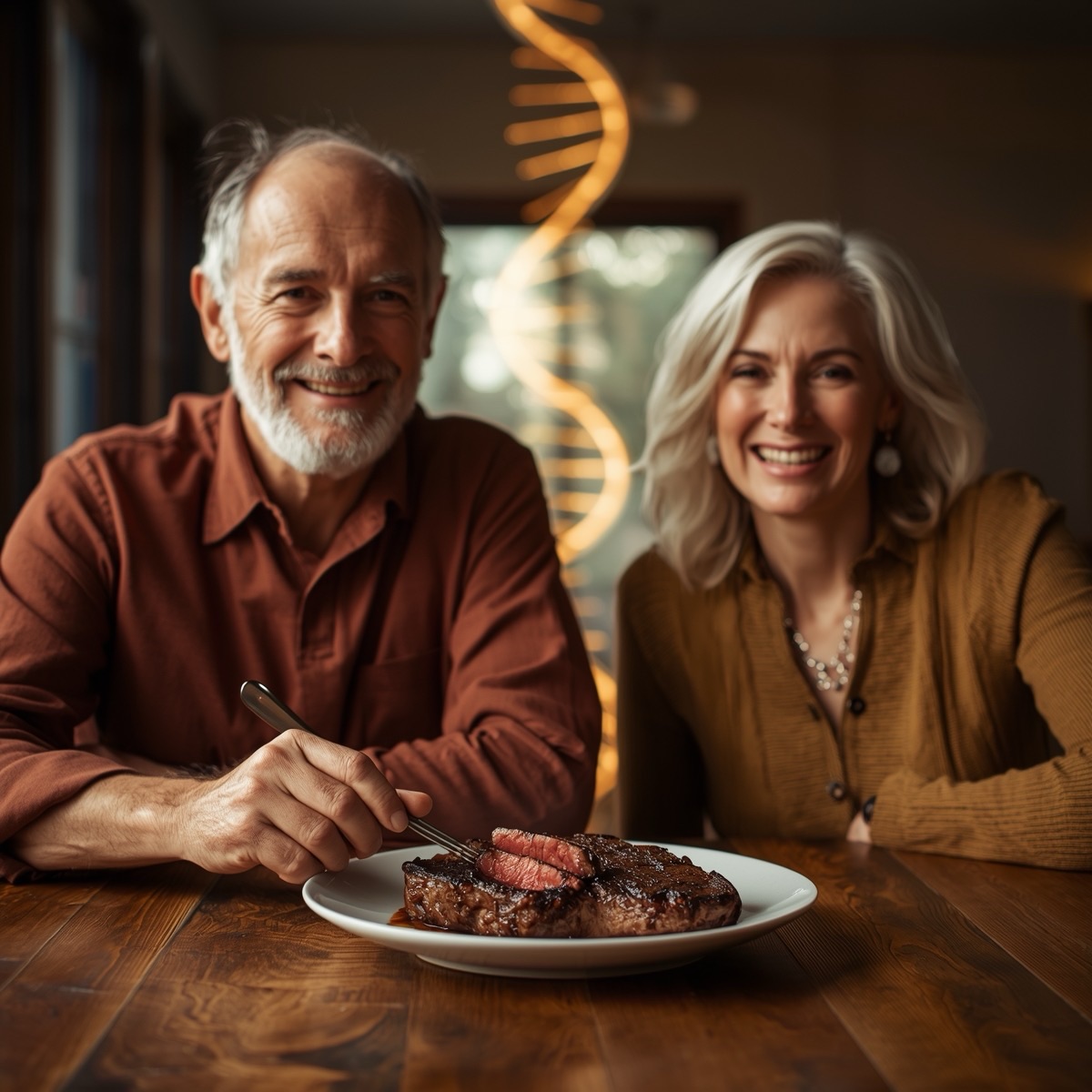
What if the foods on your plate quietly affect the age of your cells? A small study found a surprising link between red meat and a marker of cellular youth. Let’s unpack the science — in plain language.
Aging and the Shoelace Problem
Imagine your DNA as a shoelace. At the ends, you’ve got those little plastic caps that keep it from fraying — that’s what telomeres do for your chromosomes. Each time your cells divide, those “caps” get a little shorter. Over time, they wear down, and that’s one reason why our bodies age. Scientists often use telomere length as a kind of biological clock.
What the Scientists Did
In 2016, researchers in Italy asked a simple but fascinating question: could the food we eat change the length of our telomeres?
They studied 28 adults, ages 18–65. Some smoked, some didn’t. Everyone filled out food questionnaires and gave blood samples so researchers could check their telomere length in immune cells.
The Unexpected Twist
You might expect fruits, vegetables, or fish to be the “winners” here. But the results told a different story.
People who ate more red meat actually had longer telomeres.
Even more surprising, fruits and vegetables didn’t show a strong link at all. Fish, often celebrated as a “longevity food,” also wasn’t connected to telomere length in this study. Another detail: people with higher education levels tended to have longer telomeres too — suggesting lifestyle and environment matter.
Should We All Start Eating Steak Every Day?
Not so fast. This was a very small study — only 28 people. It doesn’t prove that red meat keeps you young. It just shows an interesting correlation.
Still, it reminds us that nutrition science is rarely black and white. The foods we eat interact with our bodies in complex ways. Sometimes the results challenge our assumptions.
Why This Matters
For decades, red meat has often been portrayed as a “villain” in nutrition. But here’s a study suggesting it might have unexpected benefits for cellular aging. Does that mean steak is the secret to longevity? Probably not on its own. But it does highlight the importance of looking deeper before labeling foods as “good” or “bad.”
Final Thought
Science is full of surprises. Sometimes, the answers to big questions about aging and health come from the most unexpected places — like a simple dinner plate. So next time you sit down to a juicy steak, you might wonder: could this be helping my cells stay younger?
Reference
Rizza W, Veronese N, Fontana L. What are the roles of calorie restriction and diet quality in promoting healthy longevity? Nutrition & Metabolism. 2016;13:33. doi:10.1186/s12986-016-0099-3.
PubMed: https://pubmed.ncbi.nlm.nih.gov/27418163/