
(And Why Scrolling, Snacking — Especially Sugar — and Binge-Watching Leaves You Feeling Empty)
Hey friend, real talk: have you ever demolished a pint of ice cream or a party-size bag of gummy worms, felt that insane rush… and then 20 minutes later felt irritable, foggy, and weirdly ashamed?
You’re not weak-willed.
You just mainlined one of the most powerful dopamine triggers on the planet: sugar.
Sugar: The Legal Cocaine of Food
In rat studies (the numbers translate surprisingly well to humans):
- Chocolate → +55% dopamine
- Sex → +100%
- Nicotine → +150%
- Cocaine → +225%225
- Amphetamines → +1,000%¹
Plain table sugar (sucrose)?
→ +150–200% in the nucleus accumbens — matching nicotine, beating sex, and in binge doses sometimes rivaling cocaine.²
Even more shocking: when rats can choose between cocaine and sugar water, most pick the sugar. Even cocaine-addicted rats will switch.³
Food companies spent decades perfecting the “bliss point” so that donuts, Frappuccinos, and breakfast cereals hijack your reward system harder than nature ever intended.
The Pain-Pleasure Seesaw
Every quick hit tips the scale toward pleasure.
Your brain instantly adds counter-weight on the pain side (opponent-process theory).⁴
Do it hundreds of times a day and the scale eventually rests tilted toward pain. That’s when fruit tastes bland, sunsets feel meh, and you need more and more just to feel normal.
Everyday Dopamine Bombs (Sugar Usually Runs the Show)
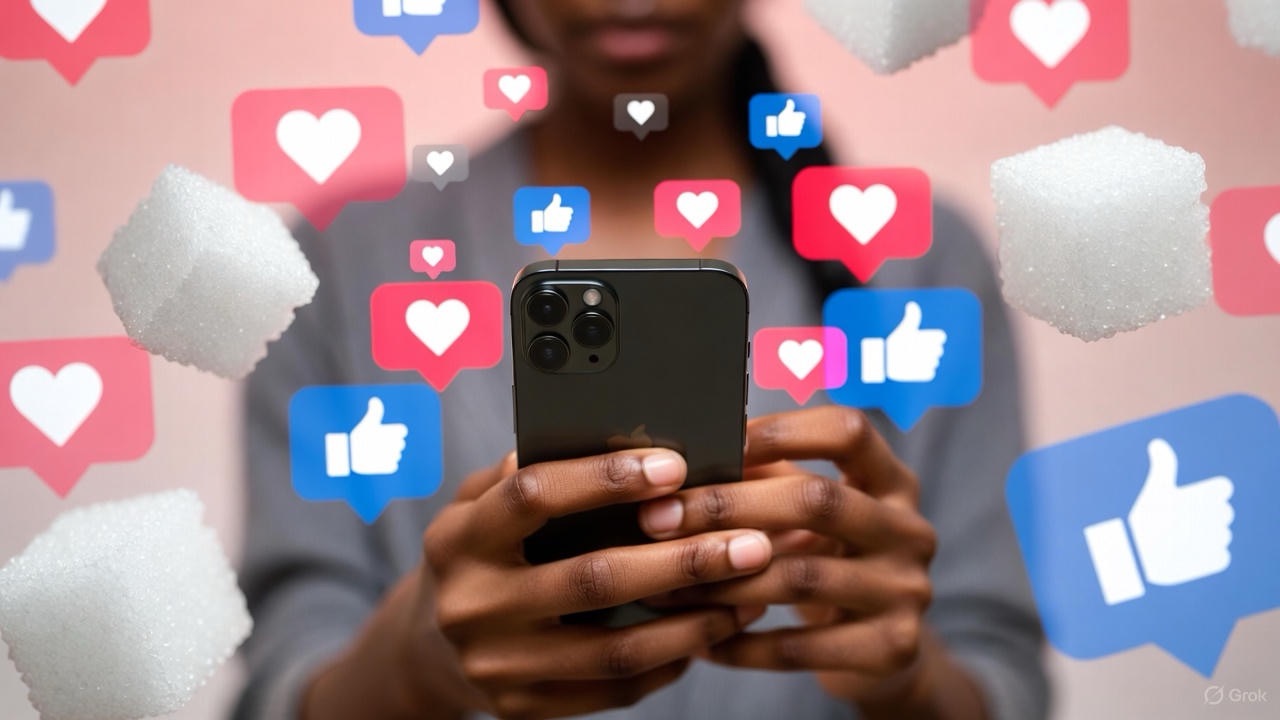
- Social media likes & infinite scroll
- Ultra-processed snacks & sugary drinks
- Bliss-point desserts and candy
- Porn & hyper-novel erotic content
- Loot boxes and gaming streaks
- Online shopping dopamine loops
- Sports betting apps
- Binge-watching with auto-play
- Alcohol (which pairs terrifyingly well with sugar)
The Way Out (It Works Faster Than You Think)
Cut the obvious high-dopamine triggers — especially added sugar — for 30–90 days and people routinely report:
Week 1: cranky, headaches, cravings
Week 2: energy evens out
Week 3–4: an apple tastes like candy, music hits deeper, random bursts of real joy return
10 Science-Backed Ways to Reset the Scale
- Exercise & movement⁵
- Cold exposure⁶
- Time-restricted eating or occasional fasting⁷
- Meditation & mindfulness⁸
- Deep, protected sleep⁹
- Real novelty & learning¹⁰
- Nature & sunlight¹¹
- Genuine human connection & touch¹²
- Creative expression
- Acts of service¹³
The single biggest lever for most people? Dropping added sugar and ultra-processed food first. Everything else becomes dramatically easier.
If you’re in the pub right now with a pint in one hand and a basket of chips in the other… maybe make this your last round tonight, skip dessert, and walk home.
Your brain will hate you for 48 hours.
Then it will love you for the rest of your life.
You’ve got this.
Put the donut down. Real joy is on the other side.
With love and a clearer head,
— Someone who’s been exactly where you are
References
¹ Di Chiara & Imperato (1988). Drugs abused by humans preferentially increase synaptic dopamine concentrations in the mesolimbic system of freely moving rats. PNAS.
² Avena et al. (2008). Evidence for sugar addiction: Behavioral and neurochemical effects of intermittent, excessive sugar intake. Neuroscience & Biobehavioral Reviews.
³ Lenoir et al. (2007). Intense sweetness surpasses cocaine reward. PLoS ONE.
⁴ Solomon & Corbit (1974). An opponent-process theory of motivation. Psychological Review.
⁵ Greenwood & Fleshner (2011). Exercise, stress resistance, and neurogenesis. Neuromolecular Medicine.
⁶ Šrámek et al. (2000). Human physiological responses to immersion into water of different temperatures. European Journal of Applied Physiology.
⁷ Mattson et al. (2018). Impact of intermittent fasting on health and disease processes. Ageing Research Reviews.
⁸ Brewer et al. (2011). Mindfulness training reduces craving-related neural activity. PNAS.
⁹ Walker (2017). Why We Sleep – dopamine receptor recovery during deep NREM.
¹⁰ Koepp et al. (1998). Evidence for striatal dopamine release during video game play. Nature.
¹¹ Lambert et al. (2021). Spending time in nature reduces rumination and amygdala activity. Scientific Reports.
¹² Uvnäs-Moberg et al. (2015). Oxytocin and dopamine interactions in social bonding. Psychoneuroendocrinology.
¹³ Harbaugh et al. (2007). Neural responses to taxation and voluntary giving reveal motives for charitable donations. Science.