
For years, when we talked about obesity and type 2 diabetes, the conversation usually stayed in the same few places: the liver, the muscles, and fat tissue. We thought of these as the main “engines” that handle sugar and insulin.
But a groundbreaking new study just published in the journal Science has shifted the entire spotlight. It turns out the real culprit behind insulin resistance might not be the organs themselves, but the “pipes” that lead to them: your blood vessels.
New research suggests insulin resistance starts in the vascular lining.
The Hidden Traffic Jam
Think of insulin as a VIP guest trying to get into an exclusive club (your muscle cells) to deliver a message: “It’s time to burn sugar.” Usually, the guest arrives, the doors open, and everything runs smoothly.
In someone with obesity, scientists have long known that the guest gets stuck outside. But this new research shows that the problem starts even earlier—in the hallway leading to the club. That “hallway” is the endothelium, the thin layer of cells lining your blood vessels.
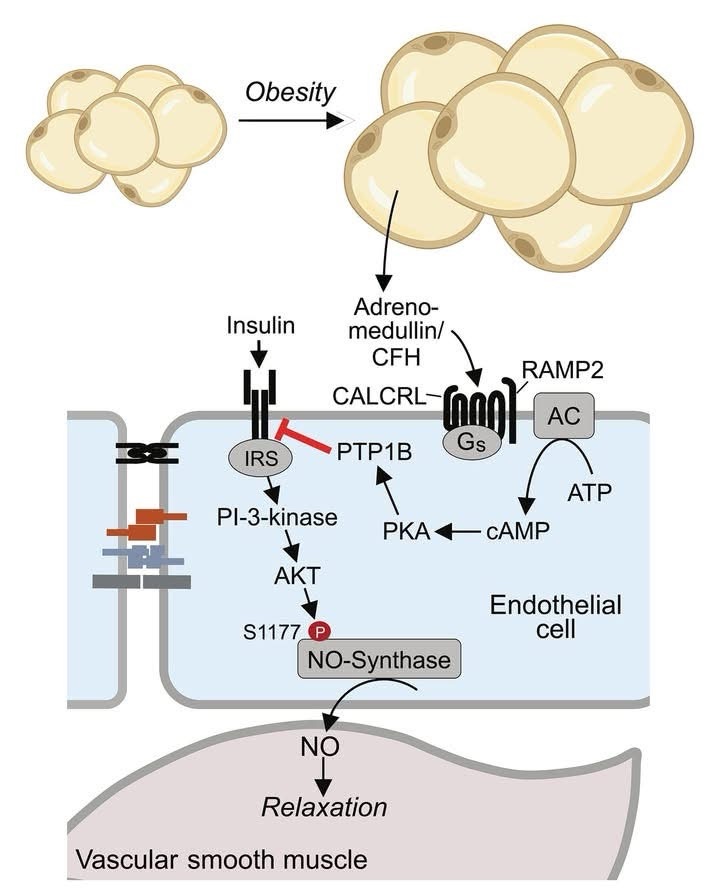
The study found that in cases of obesity, the body produces high levels of a hormone called adrenomedullin. While this hormone usually helps regulate blood pressure, in high doses, it acts like a “blockade.” It essentially shuts down the insulin receptors on the vessel walls themselves.
“If the insulin can’t get through the vessel wall and into the tissue, it just sits in the bloodstream, causing sugar levels to spike.”
Why This Matters
When the blood vessels become “insulin resistant,” two bad things happen simultaneously:
- The Flow Stops: Normally, insulin tells your blood vessels to widen so more blood (and nutrients) can reach your muscles. Adrenomedullin stops this from happening.
- The Delivery Fails: The insulin is physically blocked from reaching the muscles. This leads to the systemic insulin resistance we call Type 2 Diabetes.
A New Map for Treatment
The most exciting part of this discovery is that it gives us a brand-new target for medicine. In the study, researchers found that when they blocked the adrenomedullin receptor—even in subjects that remained obese—their insulin sensitivity improved significantly.
Their blood vessels started “listening” to insulin again, their muscles got the nutrients they needed, and their blood sugar levels stabilized.
The Human Takeaway
This research is a powerful reminder that our bodies are incredibly interconnected. Obesity doesn’t just “clog” things; it changes the chemical signaling of our entire vascular system. By focusing on the health of our blood vessels, the future of diabetes treatment might look less like a metabolic fix and more like a cardiovascular one.
The bottom line? The “pipes” matter just as much as the “engines.”
Source: “Vascular insulin resistance driven by adrenomedullin,” Science (2024).