
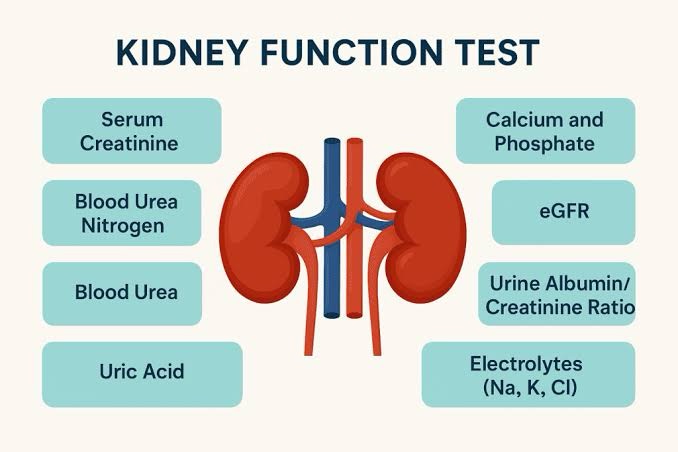
Renal function tests are essential medical investigations used to assess how well the kidneys are working. They help doctors diagnose kidney disease early, monitor disease progression, and guide treatment decisions. Because the kidneys play a vital role in filtering waste, balancing fluids, and regulating electrolytes, even mild dysfunction can have serious consequences if ignored.
Blood Urea Nitrogen (BUN)
BUN measures the amount of urea nitrogen in the blood, a waste product formed from protein metabolism. When kidney function declines, urea is not effectively excreted and BUN levels rise.
- Increased in kidney failure and dehydration
- May be elevated with high protein intake or gastrointestinal bleeding
- Low levels may be seen in liver disease or malnutrition
Serum Creatinine
Serum creatinine is one of the most reliable single indicators of kidney function. It is produced from normal muscle metabolism and removed from the blood by the kidneys.
- Rises when glomerular filtration rate (GFR) decreases
- Relatively stable day to day
- Affected by muscle mass, age, and sex
Creatinine Clearance
Creatinine clearance provides an estimate of the glomerular filtration rate (GFR). It reflects how efficiently the kidneys clear creatinine from the blood.
- Requires a 24-hour urine collection
- More accurate than serum creatinine alone
- Decreases in kidney dysfunction
Glomerular Filtration Rate (GFR)
GFR is considered the best overall indicator of kidney function. It estimates how much blood the kidneys filter per minute.
- Calculated using serum creatinine, age, sex, and sometimes ethnicity
- Reduced in chronic kidney disease (CKD)
- Used to stage kidney disease severity
Urinalysis
Urinalysis examines the physical, chemical, and microscopic properties of urine. It is a simple yet powerful tool for detecting kidney and systemic diseases.
- Detects protein, glucose, ketones, blood, and infection
- Identifies inflammation, stones, or urinary tract infection
- Often the first abnormal test in kidney disease
Electrolytes
The kidneys regulate electrolytes that are critical for nerve, muscle, and heart function. Electrolyte imbalance often reflects impaired renal function.
- Sodium, potassium, chloride, bicarbonate
- Abnormal levels may cause weakness, arrhythmia, or confusion
- Essential for fluid and acid–base balance
Osmolality Tests
Osmolality tests measure the concentration of dissolved particles in blood and urine. They assess the kidney’s ability to concentrate or dilute urine.
- Abnormal values suggest impaired concentrating ability
- Helps evaluate dehydration or overhydration
- Useful in electrolyte disorders
Urine Protein Tests
These tests detect excess protein loss in urine. Proteinuria is a key marker of kidney damage.
- Indicates glomerular or tubular injury
- Common in diabetes and hypertension
- Used to monitor disease progression
Microalbuminuria
Microalbuminuria detects very small amounts of albumin in urine that are not seen on routine testing. It is an early warning sign of kidney damage.
- Early marker of diabetic nephropathy
- Important in hypertension management
- Allows early intervention to prevent progression
Imaging Studies
Imaging studies provide structural information that blood and urine tests cannot. They help identify anatomical causes of kidney disease.
- Ultrasound assesses kidney size and structure
- CT or MRI detect stones, obstruction, or tumors
- Complements laboratory investigations
Renal Biopsy
A renal biopsy is performed when the diagnosis is uncertain or when detailed tissue information is needed. It involves examining kidney tissue under a microscope.
- Provides definitive histological diagnosis
- Guides treatment in glomerular diseases
- Used selectively due to procedural risks