
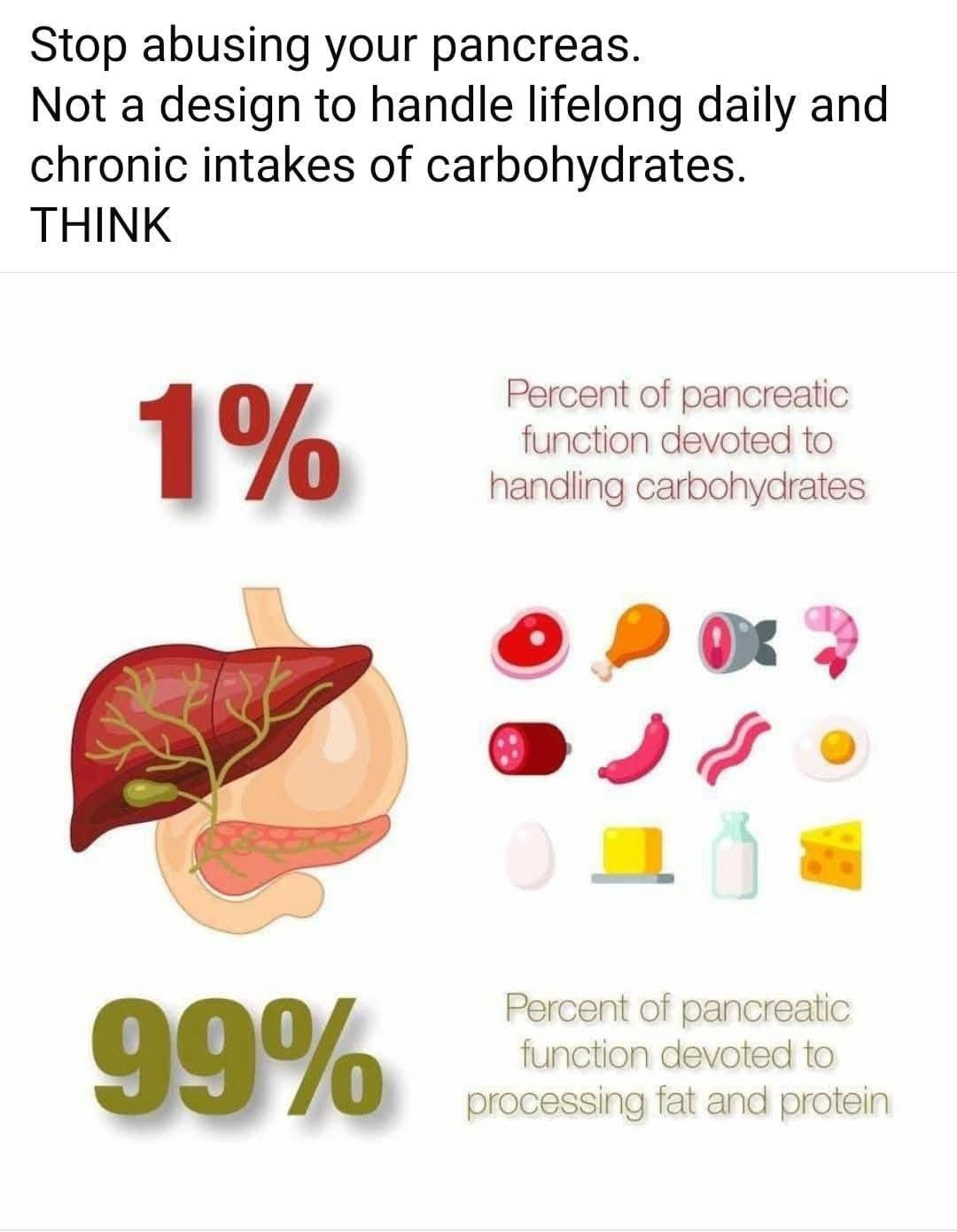
When you look closely at the human pancreas, its design and priorities become obvious — and humbling. The pancreas is an elegant organ that supports both digestion and blood sugar regulation. Yet modern eating habits, especially high-carbohydrate diets, are completely misaligned with how this organ was built to function. Here’s what the science of histology and physiology reveals.
The Endocrine Pancreas: Just 1% of the Job
The endocrine pancreas — the part responsible for producing hormones that regulate blood sugar — accounts for only 1–2% of the pancreas by mass. It consists of scattered nests of cells known as the islets of Langerhans, which contain just four major cell types:
Alpha (A) cells: secrete glucagon, raising blood sugar when it’s low. Beta (B) cells: secrete insulin, lowering blood sugar after a meal. Delta (D) cells: secrete somatostatin, which modulates both insulin and glucagon release. PP (F) cells: secrete pancreatic polypeptide, involved in digestive processes.
That’s it — one percent of the pancreas handles all your body’s carbohydrate metabolism needs. It was never designed to process massive, frequent, lifelong surges of sugar and starch that are now commonplace in modern diets.
The Exocrine Pancreas: The Real Workhorse
Contrast that with the exocrine pancreas, which accounts for 85–90% of the gland’s volume. This is the machinery responsible for digesting the food you eat — primarily fat and protein. The tissue composition of the pancreas reflects these priorities:
Exocrine pancreas: ~85% Extracellular matrix: ~10% Blood vessels & ducts: ~4% Endocrine pancreas: ~1%
The exocrine pancreas has two major cellular components:
Acinar cells: produce digestive enzymes to break down fats and proteins. Groups of 20–40 acinar cells form a unit called an acinus. Centroacinar (ductal) cells: secrete the fluids and electrolytes that carry these enzymes into the digestive tract.
These cells form a highly organized ductal system that delivers digestive secretions into the duodenum — the first segment of the small intestine.
It is clear: the pancreas is overwhelmingly dedicated to digesting fat and protein, not managing blood sugar spikes.
Rethink Your Diet: Respect the Design
Take a moment to think about these proportions:
99% of your pancreatic function is devoted to processing fat and protein. Only 1% is tasked with regulating carbohydrate metabolism.
And yet, the modern diet flips this logic on its head, bombarding the pancreas daily with refined sugars and starches that demand constant insulin output. This relentless workload exhausts beta cells, contributing to insulin resistance, metabolic syndrome, and eventually type 2 diabetes.
The Bottom Line
Your pancreas was not designed to handle the chronic, high-carbohydrate diets that have become standard. It is a remarkable organ built to thrive on a diet rich in fat and protein, with only occasional, modest amounts of carbohydrates.
So stop abusing your pancreas. Eat in alignment with your biology. Prioritize fats and proteins, and keep carbohydrates to a level that this finely tuned organ can realistically manage — about 1% of its true design capacity.
Your health, your metabolism, and your future depend on it.