
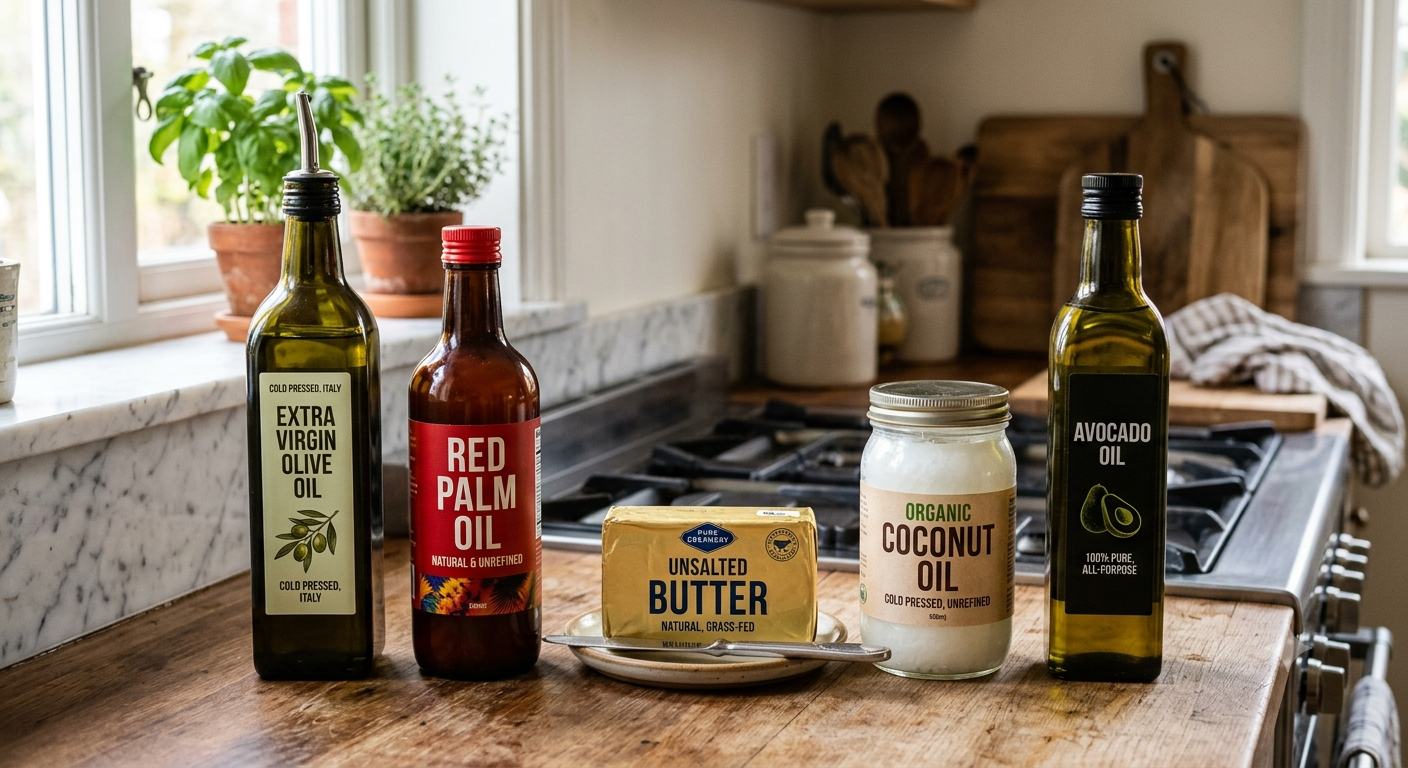
Next time you’re at the grocery store, look at the bottles bragging about “natural antioxidants.” Most people assume that’s a health claim aimed at us — antioxidants are good for the body, so more must be better.
That’s not really why they’re there. In the bottle, those antioxidants aren’t just for you. They’re keeping the oil itself from falling apart before it ever reaches your pan.
Meanwhile a block of butter or a tub of lard just sits there, unbothered, no antioxidant claims needed. Same shelf, completely different situation. The difference comes down to something pretty basic in the chemistry: whether the fat has double bonds.
Why unsaturated oils are under constant attack
Oils like flaxseed, olive, and avocado stay liquid at room temperature because their fat molecules contain double bonds — kinks in the carbon chain that stop the molecules from packing tightly together.
That kink is also a weak point. Wherever there’s a double bond, oxygen can get in. Once it does, it starts stripping electrons, generating free radicals, and breaking the fat down into aldehydes and ketones — the stuff that makes old oil smell like wet cardboard and taste faintly metallic. This is lipid oxidation, and it’s not slow or subtle once it gets going.
The antioxidants are there to take the hit
Every fragile oil comes with its own defense package, more or less strong depending on how many double bonds it’s carrying:
- Extra virgin olive oil has oleocanthal (that peppery bite at the back of your throat) and hydroxytyrosol, backed up by alpha-tocopherol, one form of vitamin E.
- Flaxseed oil is about as fragile as oils get — it depends on lignans and gamma-tocopherol, and even then it really needs to live in the fridge to hold up.
- Avocado oil has lutein, a carotenoid pigment, plus standard vitamin E, which is enough given how comparatively stable its fat profile is.
- Unrefined red palm oil is the standout — loaded with alpha- and beta-carotene (hence the deep red color) and tocotrienols, a rarer and more potent vitamin E variant. It’s about as well-defended as a natural oil gets.
Where it goes wrong: ultra-processed seed oils
Canola, corn, soybean, cottonseed, sunflower — these are extracted with high heat, high pressure, and solvents like hexane. The seeds themselves are full of delicate polyunsaturated fats, and the processing wrecks their natural antioxidants and starts oxidizing the oil before it’s even bottled.
To cover that up, manufacturers bleach and deodorize it. Then when you cook with it at home, it breaks down further and releases compounds like 4-HNE, which is genuinely toxic to cells, along with other polar compounds. Eat enough of that and you’re looking at inflammation, cellular stress, and damage to the gut lining.
What oxidized oil actually does to your body
It’s worth being specific about this, because “rancid oil is bad for you” undersells it. Oxidized oil isn’t just lower quality — the breakdown products are actively harmful.
- Aldehydes like 4-HNE are cytotoxic, meaning they damage cells directly. They’ve been linked to oxidative stress in the liver and to disrupting normal cell signaling.
- Repeated inflammation. Oxidized fats trigger inflammatory pathways in the gut and bloodstream. Eaten regularly, this looks like the kind of low-grade chronic inflammation tied to metabolic syndrome, insulin resistance, and cardiovascular disease.
- Gut lining damage. Oxidized lipids appear to weaken the intestinal barrier, which is part of why they’re associated with gut permeability issues (“leaky gut”).
- It compounds with heat and reuse. This is why reused deep-frying oil is a particular problem — every heating cycle oxidizes it further, and polar compounds build up with each round. Many countries actually regulate how many times frying oil can be reused for exactly this reason.
- Oxidized cholesterol is its own concern, separate from cholesterol itself — oxidized LDL is what’s more directly implicated in artery plaque formation, not native LDL.
None of this requires eating something obviously spoiled. Oil that’s been sitting open on a counter for months, or reused for frying multiple times, can be oxidizing well before it smells or tastes “off.”
Watch out for “refined” olive oil
Here’s a trap worth knowing about: bottles labeled “pure olive oil” or “light tasting olive oil.” These are refined, meaning they’ve been through industrial heat and chemical filtration that strips out the oleocanthal and hydroxytyrosol.
You end up with oil that still has the same vulnerable double bonds as extra virgin, but none of the antioxidant protection. It oxidizes faster on the shelf and in the pan. If you’re buying olive oil, extra virgin is really the only version worth getting.
How a living salmon keeps its fat from going rancid
Salmon carry a lot of long-chain omega-3s — EPA and DHA — which can have up to six double bonds per molecule. On paper these are about the most oxidation-prone fats that exist. And salmon spend their lives in oxygen-rich water, generating heat and muscle stress while swimming hundreds of miles upstream. That should be a recipe for their fat breaking down constantly.
It doesn’t, because of astaxanthin — a carotenoid antioxidant roughly 6,000 times stronger than vitamin E, which salmon get from eating krill and shrimp. They deposit it directly into muscle tissue, right alongside the omega-3s, where it intercepts free radicals before they reach the fragile fat. That’s also why salmon flesh is pink — it’s basically dyed by its own bodyguard.
Worth noting: once the fish is caught and cooked, that protection stops working over time, which is part of why leftover fish turns “fishy” faster than leftover beef or pork.
Saturated fats don’t need any of this
Coconut oil, butter, lard, other animal fats — these are solid or semi-solid because their carbon chains are fully saturated with hydrogen. No double bonds, no weak points. The molecule is straight and tightly packed, and oxygen has nothing to grab onto.
Lard is actually a bit more interesting than people give it credit for. It’s not purely saturated — it’s roughly 40% saturated, 45% monounsaturated (mostly oleic acid, the same fat found in olive oil), and only 10-12% polyunsaturated. Because that fragile PUFA fraction is so small, lard doesn’t need a big antioxidant defense to stay stable. Its shelf life and frying performance come down to having very few double bonds to attack in the first place, not to any vitamin content.
Ultra-refined palm oil (the double-fractionated liquid kind) works on the same logic. Refining does strip out its original carotenoids and vitamin E, but that doesn’t matter much because its fatty acid makeup is already dominated by saturated and monounsaturated fat, with PUFA content under 10%. It can handle extreme heat and repeated frying without much oxidation — not because it’s protected, but because there’s not much for oxygen to attack.
What this actually means in your kitchen
- Fragile, high-antioxidant oils — extra virgin olive oil, avocado oil, flaxseed oil especially — deserve dark glass, tight lids, and in flaxseed’s case, the fridge. Skip refined olive oil entirely.
- Canola, soybean, and corn oil arrive in your kitchen already partly oxidized. They don’t hold up well under heat, and there’s not much upside to using them.
- Cook fish fresh when you can. The pink color really is a sign the antioxidant protection is still intact, and that protection fades once the fish is cooked and sitting in the fridge.
- For high-heat, long-duration frying, lard, butter, and ultra-refined palm olein are the more forgiving choices. They’re stable because of what they’re made of, not because of what’s been added to them.