
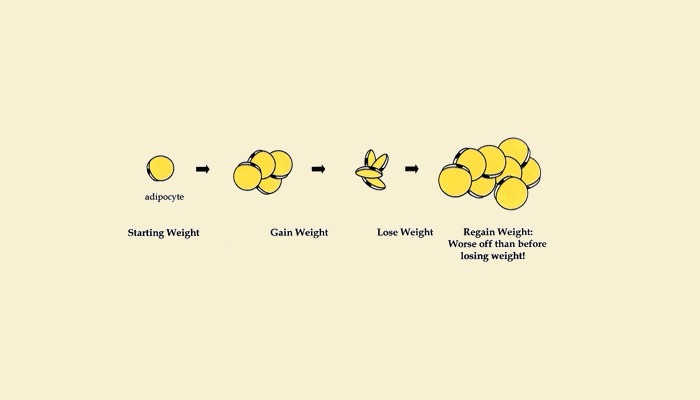
Most people think losing weight means “burning away” fat cells — as if they just melt and disappear. But here’s the truth: your fat cells don’t die when you slim down. They simply shrink.
The average fat cell in your body — also known as an adipocyte — lives for about 10 years. During that time, it goes through many changes. It can expand when you gain weight or shrink when you lose it, but the number of fat cells you have stays about the same after your teenage years.
🧬 A Fat Cell’s Lifespan
Each fat cell holds tiny droplets of fat called lipids, which your body uses as stored energy. These lipids are constantly being replaced — about six times during a fat cell’s 10-year lifespan. Think of it like a storage tank that’s always being refilled and emptied, depending on how much you eat and move.
In people with obesity, this “lipid turnover” slows down — meaning fat gets stored faster than it gets released. That’s one reason it can be harder to lose weight once fat cells have been filled to capacity.
👶 How Fat Cells Multiply When You’re Young
Your total number of fat cells is mostly determined during childhood and adolescence. From birth to around your early 20s, fat cells are multiplying rapidly — and by the time you reach adulthood, that number is mostly set for life.
Children who gain excess weight early often develop more fat cells than their leaner peers. Once those extra fat cells exist, they usually stick around permanently — even if the child later loses weight.
🧔 Fat Cells in Adulthood
As an adult, when you gain weight, you’re usually not making new fat cells — the existing ones just get bigger. This is called hypertrophy.
However, under certain conditions (like significant or long-term weight gain), your body might start producing new fat cells to handle the overflow. About 10% of fat cells are replaced every year as part of your body’s natural renewal cycle.
Interestingly, some areas — like your lower body — are more likely to form new fat cells than others when you gain weight.
⚖️ Why Fat Cells Don’t Disappear with Weight Loss
Here’s the tricky part: once a fat cell exists, it rarely goes away. When you lose weight, your body draws energy from the triglycerides stored inside those cells. The fat cells empty out and shrink, like deflated balloons — but they don’t vanish.
Even after major weight loss, your body replaces dead fat cells with new ones to keep the total number stable. That’s why it’s common to regain weight: those same “hungry” fat cells are always ready to refill.
Researchers call this cellular memory — fat cells seem to “remember” their larger size and can quickly store fat again if you start eating more than you burn.
🏋️♂️ What Exercise Really Does to Fat Cells
- Shrinking, not disappearing: Exercise and a calorie deficit make your body break down stored triglycerides for energy. The fat cells deflate, but they remain in place.
- Whole-body fat use: You can’t pick and choose where fat burns off. The body draws energy from fat stores all over — not just one area.
- Better metabolism: Building muscle raises your resting metabolic rate, so you burn more calories even when you’re not moving.
- Healthier fat tissue: Exercise reduces inflammation inside fat tissue and improves its ability to store and release energy properly — even without major weight loss.
- Where fat goes: The fat you burn doesn’t “sweat out” — it’s broken down into carbon dioxide and water. You exhale most of it through your breath and eliminate the rest through sweat and urine.
🌿 The Takeaway
Fat cells are stubborn — they don’t vanish with dieting or workouts. But they do shrink, and that’s what leads to a leaner, healthier body.
The key isn’t to “kill” fat cells — it’s to train them. Keep them small, responsive, and metabolically healthy through consistent movement, nutrient-dense meals, and a lifestyle that helps your body stay in balance.
When you understand how fat cells really work, you stop fighting your body — and start working with it.