
We spend a lot of time worrying about what we cook, but how often do you think about the chemical stability of the oil you’re using? Whether you’re searing a steak or whisking a salad dressing, your cooking oil is engaged in a silent, microscopic battle.
At the heart of this battle are antioxidants. Often marketed as “superfood” ingredients in blueberries or kale, antioxidants are actually the unsung heroes of your pantry. Without them, your kitchen would be a much smellier—and less healthy—place.
1. The Enemy: What is Oxidation?
To understand why antioxidants matter, we first have to meet the villain: Oxidation.
Think of oxidation as “chemical rusting.” Just as oxygen and moisture turn a shiny iron nail into a brittle, orange mess, oxygen and heat turn fresh cooking oil into a toxic, foul-smelling liquid. This process is called autoxidation, and it happens in three stages:
1. Initiation: A “spark” (like heat, light, or air) knocks a hydrogen atom off a fat molecule, creating a Free Radical.
2. Propagation: This free radical is unstable and “hungry.” It attacks neighboring molecules to steal their atoms, creating a chain reaction that spreads through the bottle like wildfire.
3. Termination: The oil breaks down into tiny, stinky fragments called aldehydes and ketones. This is what we call Rancidity.
2. The Hero: How Antioxidants Stop the “Chain Reaction”
Antioxidants are the “bodyguards” of the oil world. They have a very specific job: sacrifice.
When a free radical starts looking for a molecule to attack, the antioxidant steps in front of the bullet. It doesn’t just block the attack; it donates a hydrogen atom to the radical to stabilize it.
Because the antioxidant remains stable even after giving up an atom, the chain reaction stops dead in its tracks. Without these bodyguards, one single “spark” of heat could turn your entire pan of oil into a sea of unstable molecules.
3. The “Ultra-Refined” Trap: Why “Pure” Isn’t Better
Here is the secret the food industry rarely mentions: The more “refined” an oil is, the more defenseless it becomes.
When you buy “Ultra-Refined” vegetable, corn, or canola oil, it has gone through an intense industrial process involving high heat (up to 240°C), bleaching, and chemical solvents like hexane.
• Stripped Bare: This process is designed to give oil a high smoke point and a neutral taste by removing “impurities.” Unfortunately, those “impurities” are actually the natural antioxidants, polyphenols, and Vitamin E.
• The Result: You are left with a “naked” fat. While it might look clear, it has almost zero natural defense against heat.
• The Irony: Because the natural antioxidants are destroyed during refining, manufacturers often have to spray synthetic antioxidants (like TBHQ or BHT) back into the oil just to keep it from smelling rotten on the store shelf.
Bottom Line: Ultra-refined oils are “empty fats”—they provide calories but offer no chemical protection for your body once the heat is turned on.

4. The Winners: Why You Should Switch to “Real” Oils
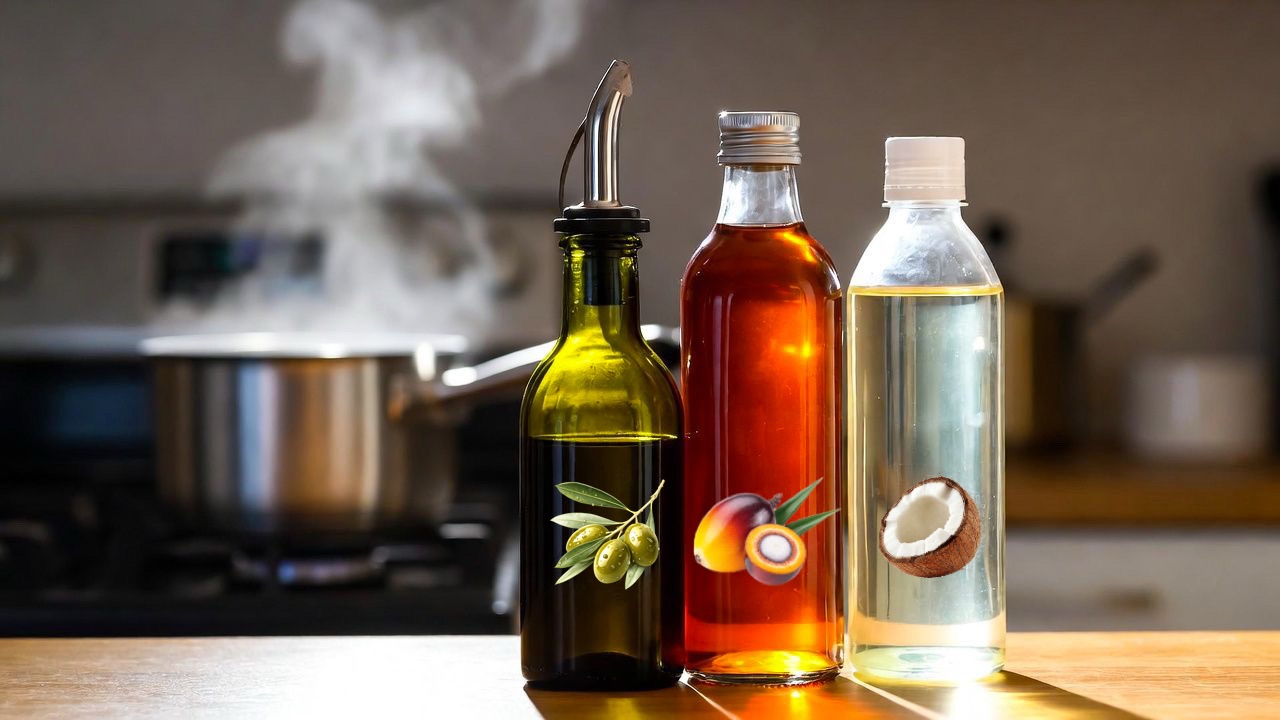
If you want to protect your health, you need oils that come with their own built-in security systems. Here are the three heavy hitters you should have in your kitchen:
A. Extra Virgin Olive Oil (The Polyphenol Powerhouse)
Extra Virgin Olive Oil (EVOO) is essentially a fruit juice. Because it is “cold-pressed,” it retains a massive army of polyphenols and Vitamin E. These antioxidants are so effective that even though olive oil has “weak spots” (monounsaturated bonds), the antioxidants protect it from breaking down during normal cooking.
B. Red Palm Oil (The Antioxidant King)
Don’t confuse this with refined “Palm Olein.” Virgin Red Palm Oil is deep orange because it is loaded with carotenoids (the same antioxidants in carrots) and tocotrienols (a very potent form of Vitamin E). It has one of the highest antioxidant counts of any cooking oil, making it incredibly stable under heat.
C. Coconut Oil (The Stone Fortress)
As we discussed, Coconut Oil is a Saturated Fat. It doesn’t need a huge army of antioxidants because its molecular structure is already “closed” to oxygen. Every single carbon bond is saturated with hydrogen.
While it has fewer antioxidants than red palm oil, its structural stability makes it one of the safest oils for high-heat frying.
5. The Health Connection: LDL and Your Heart
Why should you care if your oil is a little oxidized or stripped of its guards? Because it changes how your body processes cholesterol.
When you eat rancid or antioxidant-poor oil, those “bodyguard-less” radicals enter your bloodstream and attack your LDL (the “bad” cholesterol). This creates Oxidized LDL (oxLDL).
Your immune system doesn’t recognize oxLDL; it sees it as a foreign invader. White blood cells (macrophages) attack the oxLDL, eventually becoming bloated “foam cells” that stick to your artery walls.
This is the primary driver of atherosclerosis (hardening of the arteries). It’s not just the amount of fat you eat, but the stability of that fat that determines your heart health.
6. The Coconut Oil Paradox: Why No Antioxidants?
If antioxidants are so important, why does Coconut Oil have so few of them?
The answer lies in its architecture. Most liquid oils (like sunflower or soybean) are “unsaturated,” meaning they have double bonds in their chemical structure. These double bonds are like open windows—easy for oxygen to break into.
Coconut oil is a Saturated Fat. Every single “window” is locked and barred with a hydrogen atom.
Because coconut oil is structurally like a “stone fortress,” it doesn’t need a high-tech “security system” (antioxidants) to stay fresh. It is naturally resistant to heat and oxygen. This is why it can sit on a shelf for a year without going rancid, even without high doses of Vitamin E.
7. How to Spot “Dead” Oil in Your Kitchen
• The Smell Test: If your oil smells like old crayons, wet cardboard, or paint, it has gone rancid. Fresh oil should smell like the plant it came from (nutty, fruity, or grassy).
• The Texture: Rancid oil becomes tacky and sticky on the bottle cap.
• The Taste: If a drop of oil tastes soapy or bitter, or leaves a scratchy sting in the back of your throat, throw it out.
Final Pro-Tips for Your Pantry
1. Ditch the “Clear” Plastic Bottles: Good oils (like EVOO) should come in dark glass or tin to protect the antioxidants from light.
2. Look for “Cold-Pressed”: This ensures the antioxidants weren’t killed in the factory.
3. Use the Right Tool: Use Coconut or Red Palm oil for high heat, and Extra Virgin Olive Oil for medium heat and dressings.