
So far, we’ve talked about:
- Pancreas → insulin (the brake)
- Liver → glucose production (the accelerator)
- Gut → signaling and inflammation (the hidden driver)
Now comes the final layer many people underestimate:
Stress, sleep, and hormones.
Your body is designed to raise blood sugar
High blood sugar is not always caused by food.
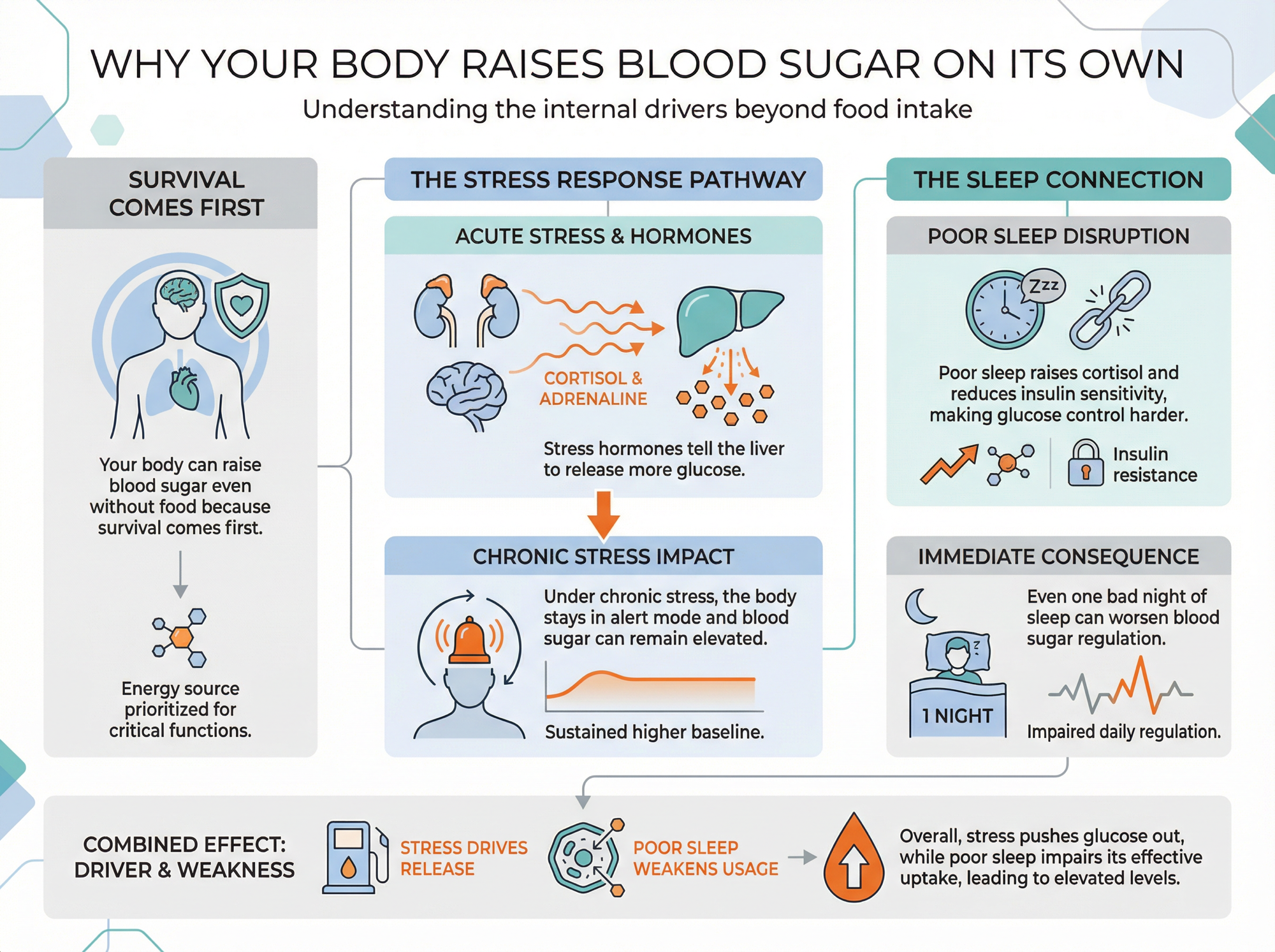
Your body can raise blood sugar on its own — even when you are not eating.
Because survival always comes first.
Key hormones involved
- Adrenaline (epinephrine)
- Cortisol
These hormones increase blood sugar to provide quick energy.
Common causes of chronic stress
- Work environment — long hours, pressure, constant demand
- Lifestyle — irregular routine, lack of rest
- Exercise — overtraining without recovery
- Malnutrition — insufficient nutrients, poor diet quality
Many people are under constant stress without realizing it.
1. Chronic stress (long-term effect)
Cortisol stays elevated, adrenaline triggers more often, and the liver keeps releasing glucose, leading to sustained high blood sugar.
The body stays in alert mode, and blood sugar can remain elevated even without food intake.
2. Acute stress (short-term response)
Adrenaline and cortisol are designed to increase blood sugar quickly for a “fight or flight” burst of energy.
This is normal — but frequent triggering becomes a problem.
3. Sleep deprivation
Sleep directly affects blood sugar control:
- Raises cortisol
- Reduces insulin sensitivity
- Increases hunger hormones
Even one night of poor sleep can disrupt glucose control.
Why this explains “stubborn” high blood sugar
- Low carb diet
- Fasting
- Good food control
But still high blood sugar?
Because your hormones are driving it — not your food.
The full system (complete picture)
- Pancreas → insulin
- Liver → glucose production
- Gut → inflammation & signaling
- Hormones → stress response
All four systems work together.
Where low carb fits in
Low carb helps to:
- Reduce glucose spikes
- Lower insulin demand
- Reduce metabolic stress
But it cannot override chronic stress and poor sleep.
What you actually need to do
This is the part many people avoid — but it matters the most.
- Rest more — your body cannot heal in constant stress
- Sleep more — consistent, deep sleep is non-negotiable
- Take breaks — even short ones reduce stress load
- Go for a holiday — step away from chronic pressure
- Rebuild your lifestyle — not just your diet
You cannot out-diet a stressed body.
Final message
If your blood sugar feels “stuck,” the issue may not be your food.
It may be your stress, your sleep, and your lifestyle.
Real metabolic recovery happens when the body feels safe — not just controlled.