
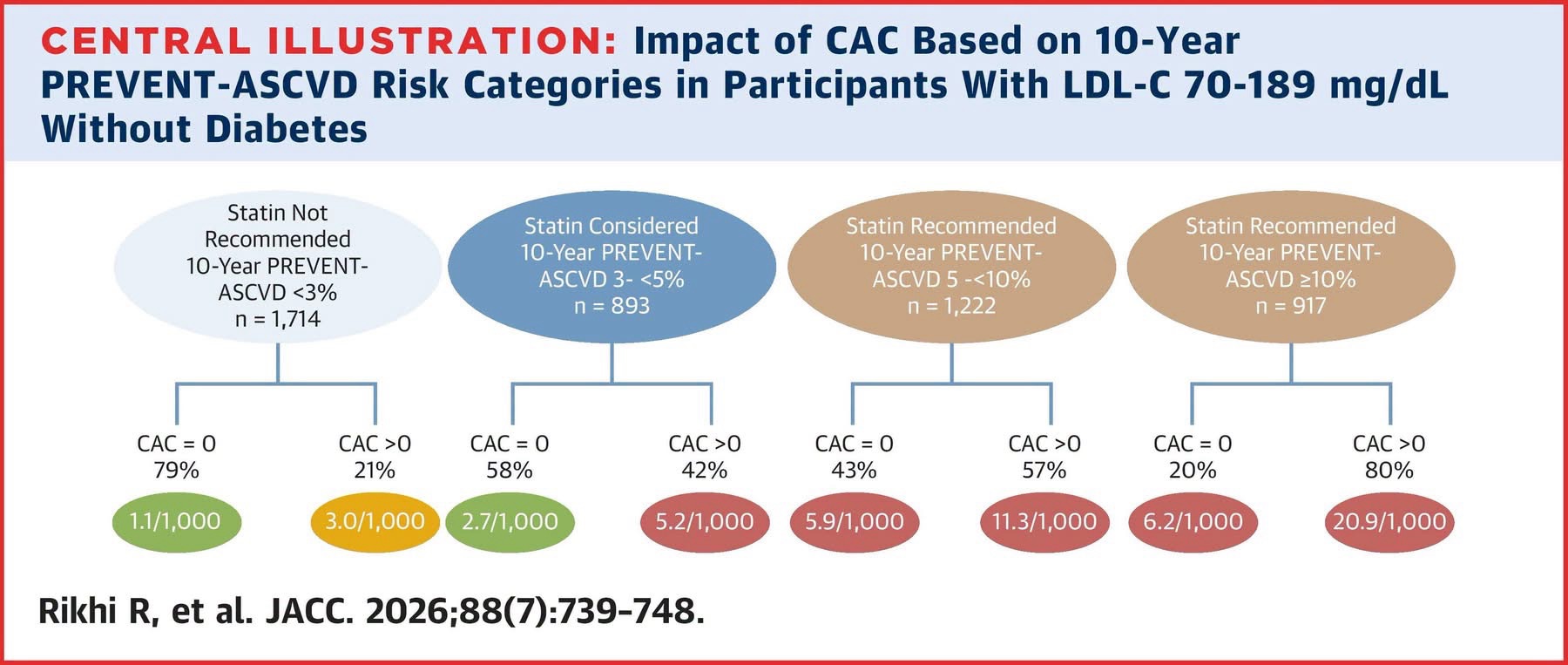
A study just came out in JACC (Journal of the American College of Cardiology) on the role of coronary artery calcium (CAC) scoring in statin decisions. It sounds like a purely clinical paper, but it actually speaks directly to a question a lot of us in the low-carb and keto community keep running into: if your LDL is high, does that automatically mean you need to be on a statin?
What the study looked at
The researchers used data from MESA (the Multi-Ethnic Study of Atherosclerosis), a large cohort that’s been tracking cardiovascular risk for over two decades.
Some context: the 2026 dyslipidemia guideline switched the standard risk calculator from the old Pooled Cohort Equations (PCE) to the newer PREVENT equations for estimating 10-year ASCVD risk.
The team split participants into three groups based on the new guideline:
- Statin not recommended
- Statin considered
- Statin recommended
Then they further broke people down into four PREVENT risk tiers (<3%, 3–5%, 5–10%, ≥10%), and looked at how actual cardiovascular event rates differed depending on CAC score within each of those groups.
What they found
The takeaway is pretty clear: CAC scoring provided the most value for people whose calculated risk landed in a gray zone — where the risk equation alone couldn’t confidently tell doctors and patients whether treatment was warranted.
In other words, if your PREVENT score falls right in that borderline range (say, 5–10%), the number alone doesn’t tell you much. But if you get a CAC scan and it comes back at zero or very low, your actual event rate looks a lot closer to the low-risk group — regardless of what the risk calculator said.
On the flip side, when someone’s risk score is already clearly high or clearly low, CAC doesn’t add nearly as much extra information.
Why this matters if you’re low-carb
A lot of people in this community have probably been here: metabolic markers all look great — normal insulin, stable glucose, good blood pressure, low inflammation — except for one thing, LDL comes back high. And then a doctor, going purely off a risk calculator score, recommends a statin.
This study gives that exact group something concrete to bring to the conversation. The risk calculator isn’t the final word, especially when you’re sitting in that in-between zone — a CAC scan gives information that’s specific to what’s actually happening in your arteries, rather than a statistical estimate built from age, sex, and cholesterol numbers alone. Whether there’s actual calcified plaque in your vessels tells you more about your individual risk than a formula does.
For a lot of LDL-high-but-metabolically-healthy low-carb eaters — often called “lean mass hyper-responders” (LMHR) — this kind of research is basically saying: don’t just react to a number on paper. Go find out what’s actually going on in your arteries first. That’s a more useful starting point than agonizing over whether your LDL is “too high.”
But let’s be honest about the limitations
This study doesn’t touch on diet at all — it’s not comparing low-carb to any other eating pattern. It’s purely evaluating how useful CAC is as a clinical decision-making tool. A few limits worth flagging:
- PREVENT scores were calculated using MESA’s baseline data, which may not reflect current risk factor distributions
- CAC results weren’t blinded to clinicians or participants, which could have influenced subsequent treatment and, in turn, event rates
- MESA was a relatively healthy cohort overall, so absolute event rates may run lower than in the general population
So to be precise: this study supports “CAC scanning has clinical value when risk is uncertain” — it does not support “low-carb is safe” or “you can ignore a high LDL.” Those are two separate claims, and it’s worth keeping that distinction clear when discussing it.
My take
If you’re doing low-carb or keto, your LDL is elevated, and you’ve been told to start a statin, rather than getting stuck arguing over the number itself, it might be worth bringing this study to your doctor and asking: can we get a CAC scan first and actually look at what’s happening in the arteries before deciding what’s next? That’s a more grounded, evidence-based place to start the conversation.
Reference: Rikhi R, Chen H, Mirzai S, et al. The Role of Coronary Artery Calcium in Statin Eligibility Based on the American Heart Association’s PREVENT Calculator: Insights From MESA. JACC. 2026. DOI: 10.1016/j.jacc.2026.05.039