
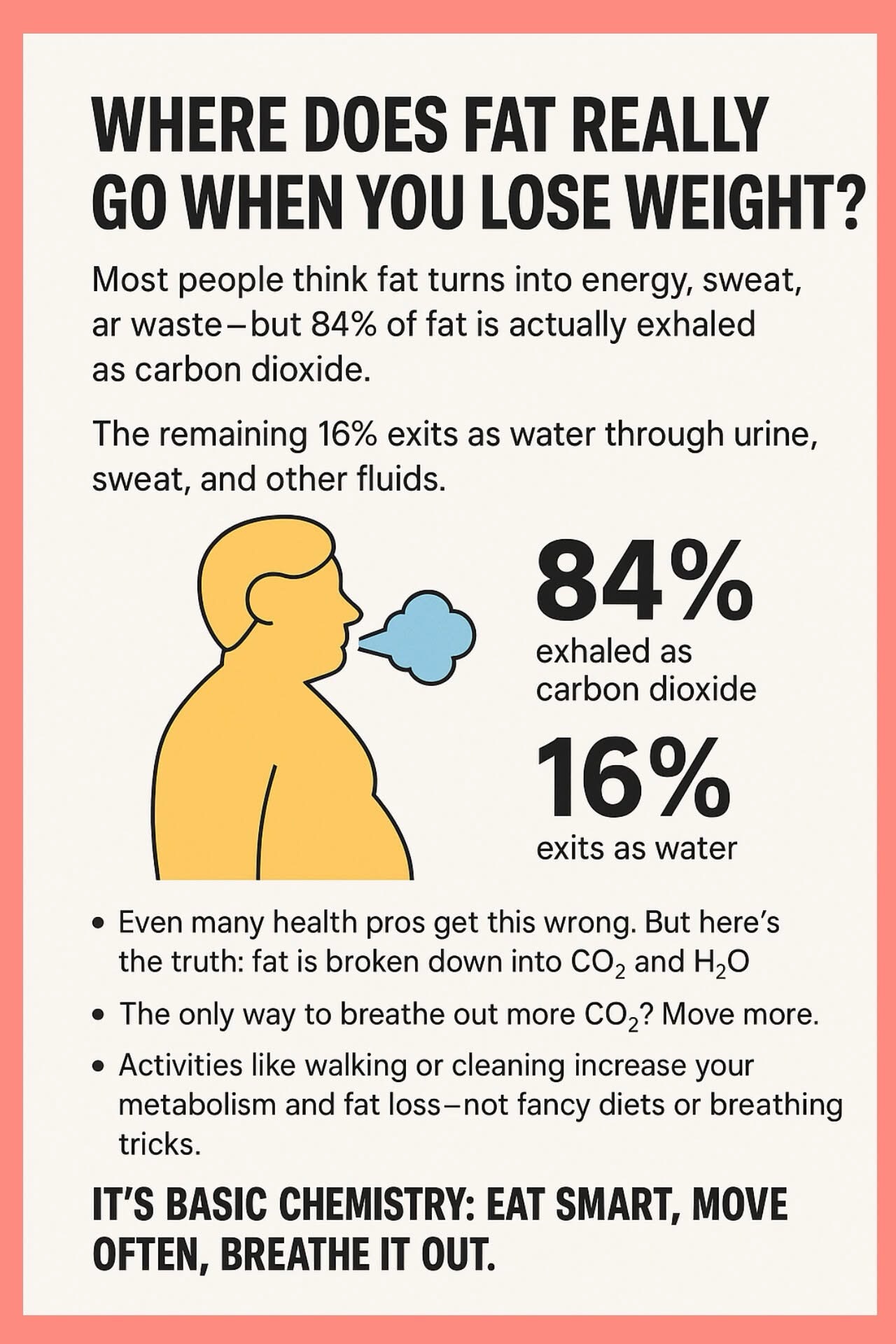
When people say they want to “burn fat,” most imagine that fat somehow melts away, turns into energy, or disappears in sweat. But the truth is far more fascinating — and surprisingly scientific.
Let’s break down exactly what happens to body fat when you lose weight, based on evidence from the Cleveland Clinic, BMJ, and other metabolic studies.
🔹 1. Fat Is Stored Energy
Fat is stored in your body as triglycerides, held inside fat cells (adipocytes). These cells are found beneath your skin (subcutaneous fat), around organs (visceral fat), and in small amounts within muscles and bone marrow.
When you consume more calories than you burn, your body converts the excess into triglycerides for storage. When you burn more energy than you eat, your body taps into those triglycerides for fuel.
Important: Fat cells don’t vanish — they shrink as stored triglycerides are broken down and used.
References:
Cleveland Clinic (2024). Where Does Body Fat Go When You Lose Weight?
NIH: Fat Metabolism and Energy Balance
🔹 2. How Fat Leaves the Body
When fat is “burned,” it doesn’t just vanish. It goes through a series of chemical steps:
- Triglycerides are split into glycerol and fatty acids.
- These molecules enter the bloodstream and travel to cells where they are oxidized in the mitochondria.
- This oxidation process converts fat into:
- Carbon dioxide (CO₂) — exhaled through your lungs
- Water (H₂O) — excreted through urine, sweat, and breath vapor
- Energy (ATP) — used for daily activity, movement, and body heat
So, most of the fat you lose literally leaves your body through your breath.
References:
The BMJ (2014): Meerman & Brown, “When somebody loses weight, where does the fat go?”
Mayo Clinic: Energy Metabolism and Exercise
🔹 3. What Happens to the Carbon and Hydrogen in Fat
Chemically, triglycerides are made of carbon (C), hydrogen (H), and oxygen (O). When oxidized, they combine with oxygen from the air you breathe to form:
- CO₂ — released through exhalation
- H₂O — expelled through sweat, urine, and breath moisture
In the landmark BMJ study, researchers found:
- About 84% of fat mass leaves as CO₂ (via exhalation)
- About 16% leaves as H₂O (via fluid loss)
That means when you lose 10 kg of fat, roughly 8.4 kg is exhaled as carbon dioxide and 1.6 kg as water.
Reference:
Meerman R., Brown A. J. (2014). BMJ, 349:g7257.
🔹 4. Why Breathing and Activity Matter
Every breath you take helps your body eliminate fat. The more oxygen you use (for instance, during exercise), the more fat you convert into CO₂ and H₂O.
This is why movement, aerobic activity, and strength training play such vital roles in fat loss:
- They increase oxygen intake and energy demand.
- They activate mitochondria to burn stored fat.
- They encourage long-term metabolic efficiency.
Tip: Even low-intensity activities — like walking or deep breathing — enhance fat oxidation over time.
🔹 5. Why “Sweating Out Fat” Is a Myth
Sweating helps regulate body temperature but doesn’t burn fat directly. The “weight” lost from sweating is mostly water and electrolytes, which quickly return after rehydration.
True fat loss comes from metabolic oxidation, not from losing fluids.
🔹 6. Supporting Healthy Fat Metabolism
- 🥦 Nutrient balance: Prioritize whole foods, protein, and fiber.
- 🚶♂️ Consistent movement: Combine strength and aerobic training.
- 😴 Adequate sleep: Regulates metabolism and hormone balance.
- 💧 Hydration: Helps process metabolic by-products.
- 🧠 Stress control: High cortisol levels can slow fat oxidation.
A healthy metabolism isn’t just about calorie counting — it’s about keeping your cells and mitochondria functioning efficiently.
🔹 7. The Takeaway
When you lose fat, you’re not sweating or “melting” it away — you’re exhaling it. Fat is converted into carbon dioxide and water through a natural metabolic process, and your lungs are the main exit path.
So every time you take a deep breath during your workout, remember: You’re literally breathing your fat away.
🔹 References
- Meerman, R., & Brown, A. J. (2014). When somebody loses weight, where does the fat go? BMJ, 349:g7257.
- Cleveland Clinic (2024). Where Does Body Fat Go When You Lose Weight?
- NIH. Fat Metabolism and Energy Balance.
- Mayo Clinic. Exercise and Energy Use in the Human Body.
- Harvard Health. How the Body Burns Fat and Carbohydrates.